A recent analysis from Pacvue on discovery commerce highlights an important shift underway early in 2026: as AI reshapes how shoppers find and evaluate products, traditional metrics are no longer sufficient. Read the full piece here.
One gap stands out clearly. Commerce platforms still lack standardized benchmarks for measuring the actual revenue impact of AI-powered discovery compared to conventional search and browsing.
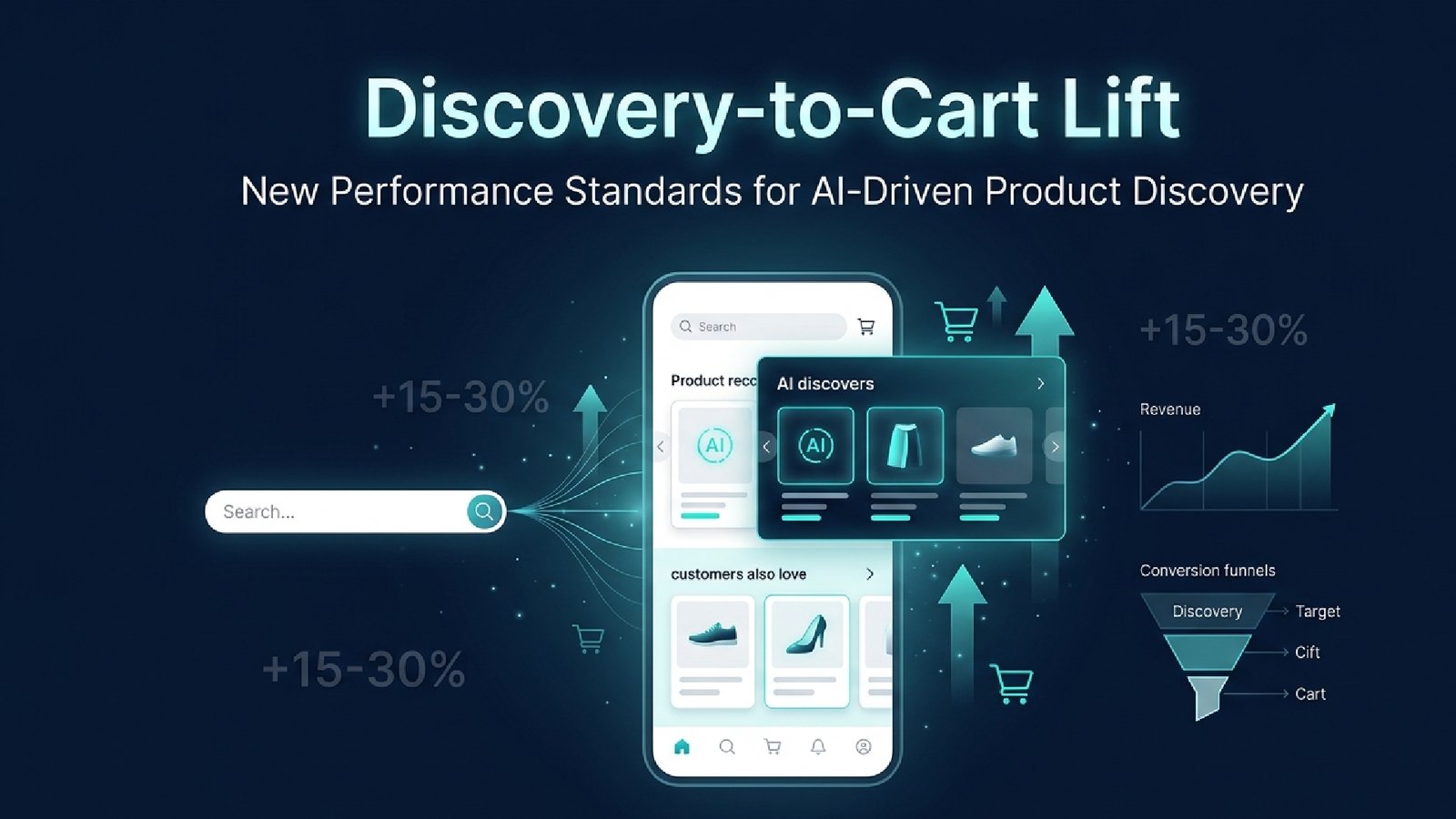
This is why we need something new, and I am suggesting a practical framework built around Discovery-to-Cart Lift.
Most commerce platforms evaluate AI recommendations using proxy signals, things like click-through rates, impression share, or add-to-cart velocity. These metrics have value, but as in every other area of marketing analytics, we keep running into the incrementality question, and thus they fall short in filling a core measurement need for enterprise teams:
How much incremental revenue comes from AI-driven suggestions compared to what would have occurred through standard keyword search or unassisted navigation?
Without this distinction, it becomes difficult to assess the true contribution of AI features or to decide where to allocate resources with confidence. As more journeys move into conversational interfaces, semantic search, and agentic experiences, the platforms that can quantify real revenue impact will stand apart.
The discovery-to-cart metric addresses these issues while offering a straightforward approach:
Baseline: Expected/historical revenue from sessions driven by traditional keyword search or standard browsing.
AI Discovery Variant: Revenue from comparable customer segments exposed to AI-generated suggestions, personalized product grids, or generative recommendations.
The Lift: The incremental difference, reported as a percentage or incremental revenue per thousand sessions.
Early testing across retailers suggests that AI discovery can deliver noticeable improvements in conversion and average order value when relevant products surface effectively. A consistent standard would turn these observations into reliable, comparable data points.
Platforms that integrate this type of measurement directly into their AI engines, rather than treating it as an after-the-fact report, will gain a clearer view of performance and the ability to optimize for proven outcomes instead of surface-level engagement.
For teams working on commerce platforms, product discovery, or analytics, here is a direct approach to put this framework in place:
Segment traffic by discovery method: Clearly separate sessions originating from traditional search versus AI recommendations or generative paths, while controlling for customer and intent variables.
Establish control baselines: Use holdout testing or causal methods to determine what revenue looks like without AI assistance.
Calculate and surface the lift: Include Discovery-to-Cart metrics in dashboards alongside existing KPIs, expressed both as percentage lift and incremental revenue contribution.
Feed results back into models: Use the lift data to refine AI ranking and recommendation logic so it prioritizes measurable revenue impact.
Develop shared benchmarks: Publish anonymized industry ranges (e.g., top-quartile performance) to help the broader market evaluate investments more effectively.
As AI continues to influence the early stages of the customer journey, the ability to measure its contribution to cart and revenue, and not just engagement, will become increasingly important. Discovery-to-Cart Lift offers one concrete way to bring greater rigor to these evaluations.
I’d be interested to hear how others are approaching measurement of AI-driven discovery in today's environment. Are you still relying mainly on engagement proxies, or have you started isolating incremental revenue from different discovery methods? Comments or connections welcome if you're working in this area.
View original on LinkedInWant to discuss this further?
Our team thinks about these problems every day. Let's start a conversation.
Book a discovery call