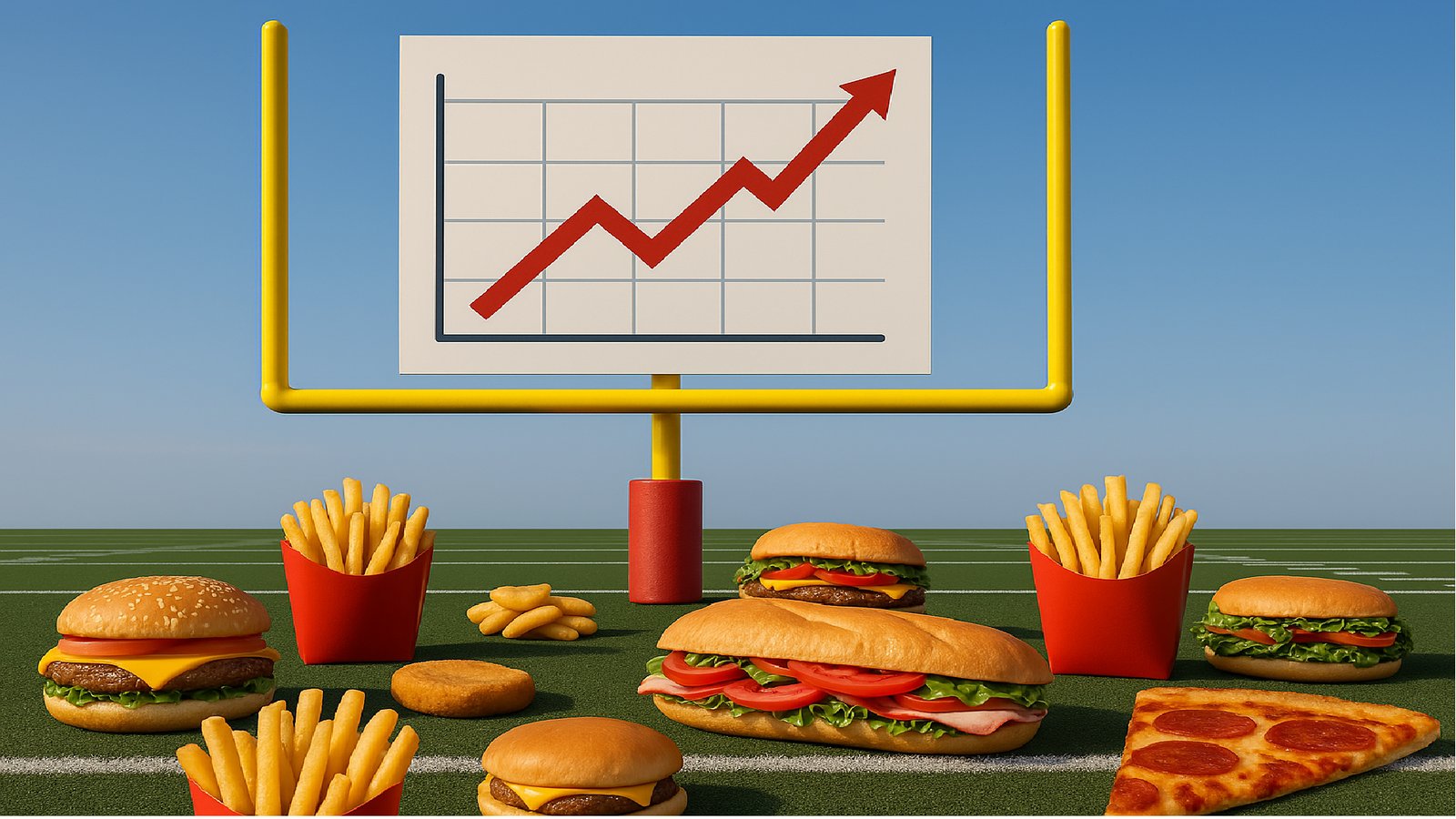
Recently, I’ve been looking into industry rules of thumb and expert proclamations around the impact of marketing initiatives like personalization and loyalty programs, and found them poorly sourced and hard to square with observed reality. What’s a better way? I’ve always used the concept of “goalposts” or upper and lower bands based on observed experience and reasonableness, to frame projections, so let’s start there. What might serve such a function for restaurants and retail?
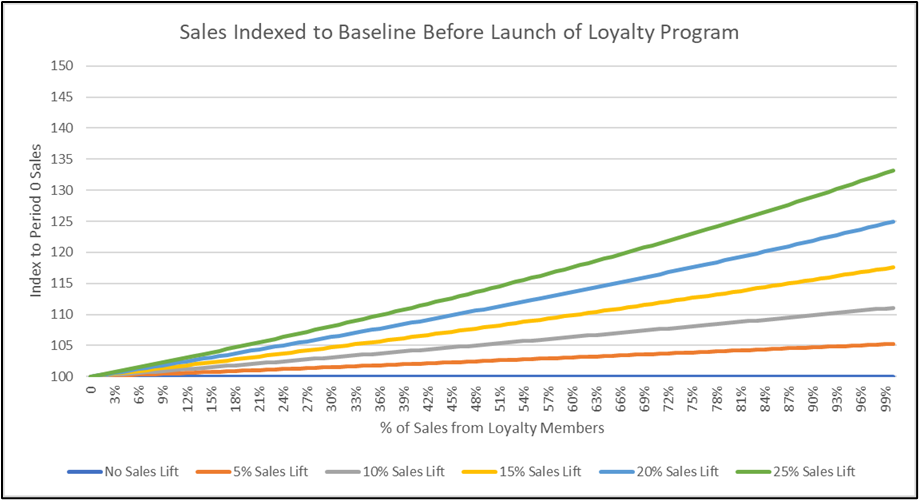
It’s easy to build a simple model to project the impact of a loyalty program, or any sustained marketing initiative, based on the percent of sales due to the program and the incremental spend attributable to the program, under the assumption that all else remains constant – calendar-driven promos, price increases, changes in non-member behavior, economic factors and other externalities. It is much harder to isolate and measure the impact in reality, so we can use this theoretical exercise as a sense check. Below is a chart with a visual representation of the model, so you can see, for example, that if you are getting 40% of your sales from loyalty members, and you believe they spend 10-15% more than non-members in a given period, you could expect an increase in sales compared to baseline within the goalposts of 4-6%.
Does this chart suggest anything like the rosy numbers commonly thrown around, like:
“…top-performing programs increasing sales by 15-25% annually. Members of loyalty programs spend 20% more than non-members”
The top end of that range is not realistic. From the chart above, we can see that if members of loyalty programs spend 20% more than non-members, and if non-member spending remains constant, you would need almost 100% of sales to come from program members to achieve a 25% increase vs. baseline. And hitting those numbers is not possible if the incremental spend is below 20%, which still seems very optimistic.
Consider Starbucks, generally thought of as one of the most successful and deeply penetrated programs, which seems to have plateaued at around 57% of sales from program members, according to this article from 2023 (https://hospitalitytech.com/starbucks-reaps-rewards-reinvention-plan) and this one from 2025 (https://medium.com/travel-marketing-insights/the-1-8-billion-latte-how-starbucks-turned-loyalty-into-a-banking-business-fe76ae8bcd9e). At the upper bound, then, Starbucks could expect to achieve a 16.5% increase in sales over baseline, assuming program members spend 25% more than non-members.
That doesn’t seem to be happening, no surprise to anyone following the company. (As I’ve discussed in the past, a loyalty program can’t overcome problems with your business model, see here: https://www.linkedin.com/pulse/can-loyalty-program-solve-troubled-business-model-john-c-keenan-klmke/ Over the period from 2010-2024, Starbucks averaged 9.4% annual growth in U.S. revenues (9.9% if we exclude 2020/2021). Some of that comes from price increases and new store openings, but we’ll ignore that for now.
If we assume that by 2010, Starbucks had 100% consumer awareness and wasn’t attracting a whole lot of new customers, that suggests the growth comes entirely from an increasing percentage of sales from program members, and therefore the lift from loyalty program members can’t possibly be as high as the 20% “rule of thumb”. From the chart, again, the upper bound would have to be no more than 15%, given the loyalty share of sales of 57%. And that means if we take into account price increases and store openings, the upper bound would be much lower, especially true for other brands with lower loyalty penetration, more likely in the range of 3-8% for a brand where only 40% of sales come from loyalty members.
Very different from the typical rules of thumb. That begs a different question: is there a better way to benchmark loyalty program performance?
View original on LinkedInWant to discuss this further?
Our team thinks about these problems every day. Let's start a conversation.
Book a discovery call