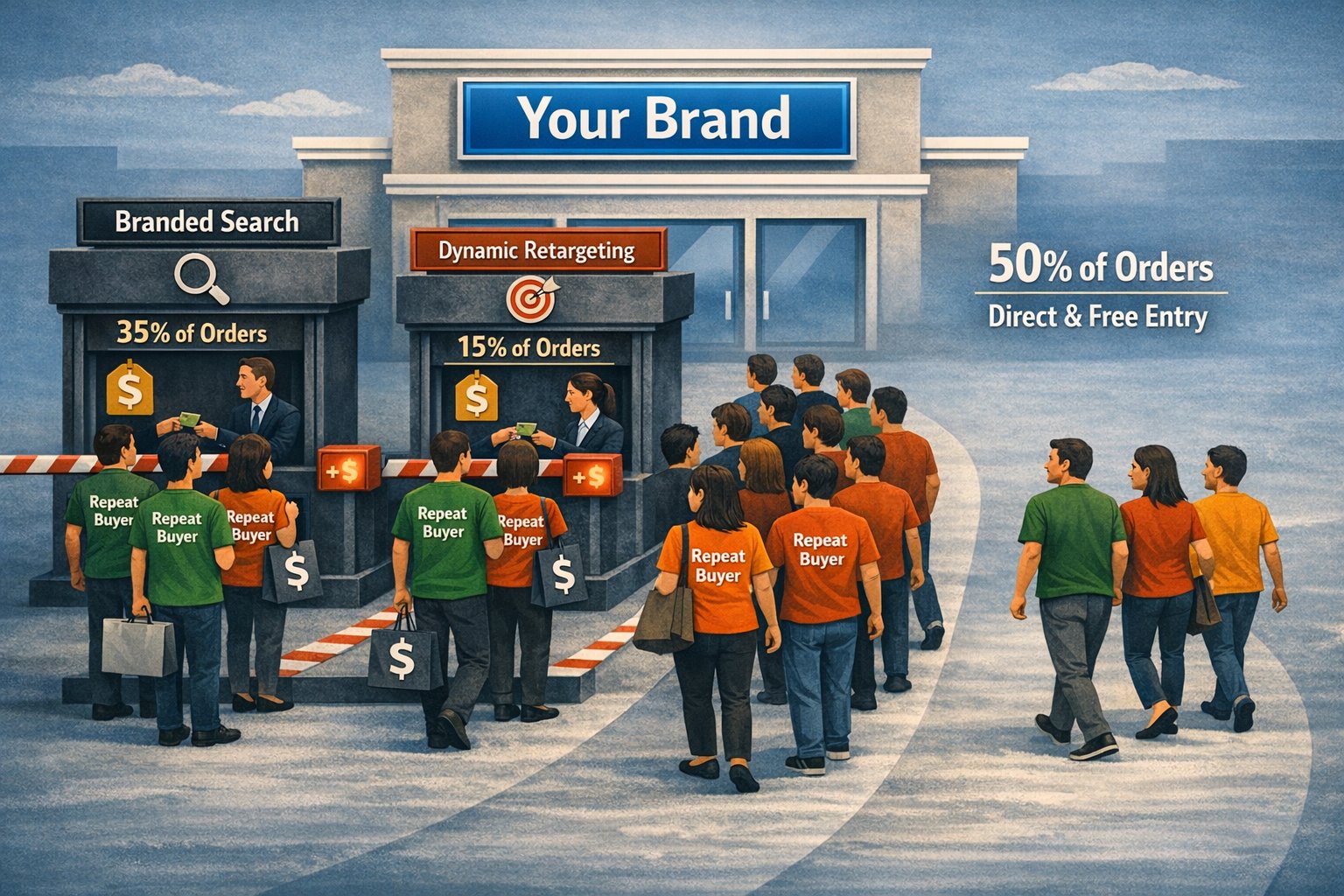
The promise of the last decade was simple: Data = Efficiency. We were told that as our models got smarter, our nets could get smaller. Especially in the age of AI targeting. In a perfect world of precision aim, marketing budgets should be shrinking as a percentage of revenue because we’re only paying for sure things.
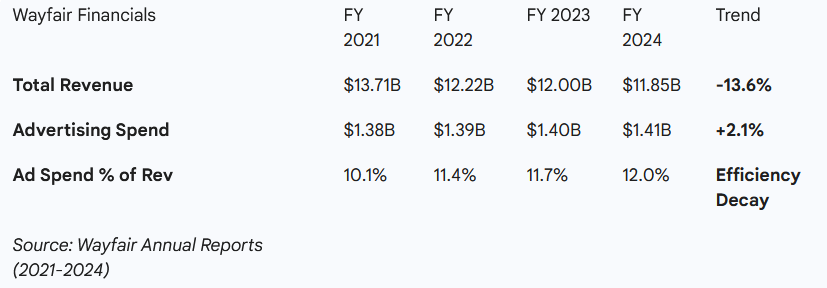
But the real-world data tells a different story. Look at Wayfair (NYSE: W) as an example. Between 2021 and 2024, Wayfair’s annual revenue actually contracted, while their advertising spend remained a massive, multi-billion-dollar "tax" required just to maintain a baseline.
Another analytical misfire of 2026 is believing that an algorithm can predict individual need. It can’t. AI and predictive models only measure likelihoods. Your "high-intent" audience, even if they have thrown off strong intent signals, isn't a group of people who will buy; it’s just a group of people who are somewhat more likely to buy than a random consumer. You are still casting a wide net - and you're paying a premium for the privilege.
The Solution: Add "Effective CAC" to your tracking and measurement approach. To see if your targeting is actually improving, it is important to look at this over time as a measure of what it costs to acquire a customer after you strip away the baseline organic growth you would have gotten for free.

Why your eCAC needs to be 3x better than "Random": If you run a campaign against a totally random control audience, you’ll still generate some sales. A 3x multiplier is the standard for proving that your precision approach is actually doing the heavy lifting. If your AI-targeted segment isn't outperforming a random sample by at least 3x, you aren't paying for a better converting audience, you're essentially paying a sophistication tax for the same old wide net.
Contrast the Wayfair plateau with the recent shift at ASOS.com . After years of chasing low-cost top-of-funnel clicks that led to a ballooning CAC and high return rates, ASOS radically reweighted their spend in 2025. They optimized their performance media model to focus on high-value, loyal customers and redeployed the waste into brand-led social and creator activity.
The result? Even as revenue faced headwinds, they improved their operating loss by over £100 million in a single year (Source: ASOS FY25 Results). They stopped trying to outbid the world for a one-time click and started focusing on the utility of their own platform.
Does this align with what you're seeing in your business? Is the eCAC concept helpful? Would love to hear other points of view. Please comment!
View original on LinkedInWant to discuss this further?
Our team thinks about these problems every day. Let's start a conversation.
Book a discovery call