I hate to keep coming back to McDonald’s, but MyMcDonald’s Rewards is such a large program and people are really paying attention to it, so it can be instructive.
In a recent LinkedIn post (here: https://www.linkedin.com/feed/update/urn:li:activity:7330602107638607875/) the author said:
“McDonald’s is quietly building a loyalty monster.”
(Done to underscore his POV that they need a stored value wallet, which is not the focus here…) Not sure it is so quiet, since McDonald’s mentions worldwide number of members and % of sales attributable to members with every quarterly earnings report, and we continually see trade industry articles written about it, but the real question is, is it a monster?
Obviously in terms of size, it is a monster – by number of members, which goes with the territory of being one of the leading restaurant chains worldwide. That’s why McDonald’s continually reports as it does, to indicate heft and establish leadership. But in terms of impact? There seem to be no reports on the effectiveness of the program. Why not?
Very simplistically, if the program was driving positive changes in behavior, assuming all other factors remain the same, it should be obvious: we should see positive changes in YoY same-store sales growth, assuming the same customers are visiting from one year to the next and the proportion who are members of the program increases over time. So that’s the first thing I would look at: same-store sales growth.
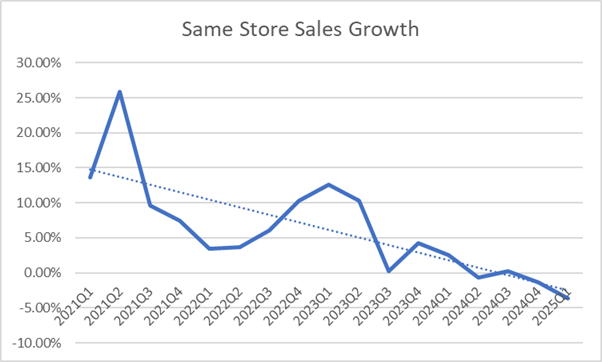
McDonald's YoY Same Store Sales Growth 2021-2025
For McDonald’s, same-store sales growth, while positive 26 out of the past 28 quarters, has been on a downward trend since the loyalty program launched in mid 2021, even accounting for the spike that is observed in 2023. Mid 2023 into Q1 2025 has seen a steady drop, which has been well covered in the press. From this data, it is hard to discern a positive impact from the loyalty program, because the curve doesn’t follow what we would expect to see. (Unless you think the economic climate has been so terrible that the program has helped weather the storm. Interestingly, that is not reflected in the stock price, which does not track at all with same store sales growth.)
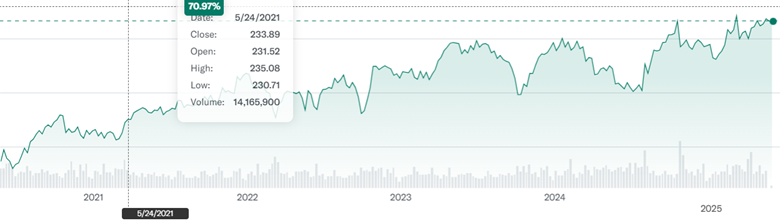
McDonald's Stock Price 2021-2025
What’s going on here? Primarily:
Any new program inherently attracts a brand’s most loyal customers first.
So what they’re really doing is taking sales that previously came from other purchase channels (in-store, drive-thru, kiosk) and now attributing them to the app/rewards program. And once the program enables tracking purchases across time for the same individual, member vs. non-member comparisons are possible. And differences can be attributed to the program.
But… it is likely that these early program adopters had higher than average visit frequency and AOV even before joining the program. So attributing differences to the program could be misleading. And it doesn’t mean that the program is driving profitable, incremental spend.
Is there anything so groundbreaking or different about MyMcDonald’s Rewards that one should be expecting it to be driving 2-3x differences in visit frequency or a 20% lift in AOV compared to non-members? Those are incredibly significant lifts. No, nothing in the rewards structure would appear to be driving that, it is not especially unique. As I’ve argued in the past (https://nventiv.ai/resources%2Fblog/f/decoupling-rewards-from-the-%E2%80%9Cdigital-experience%E2%80%9D-for-restaurants), it’s not the rewards, but the convenience afforded by the app that is driving adoption, and it’s just shifting spend among channels, not driving members to spend more.
Is this new thinking for the team at McD’s? I highly doubt it. I’m sure they’re looking at these types of metrics internally, and are probably concerned about what the results to date really show. They’ve put a tremendous amount of equity into this program, which explains why they so frequently and loudly tout easy to understand numbers that reflect the heft of the program.
To answer the original question:
# of members and % of sales attributable to a rewards program are not good metrics to measure the program’s impact.
So what are some better metrics, or a meaningful measurement approach? Since member vs. non-member is not the way, because it doesn’t account for previous behaviors or self-selection, we have to take a different tack.
Obviously the most objective set of metrics at an individual level would allow us to compare pre-membership visit and spend vs. post-membership visit and spend. That can be tough, because there is not always a way to attribute purchases to the same person without the program. If we can’t isolate that data, perhaps by grouping pre-period purchases by credit card, the next best approach would be to track visits and spend over time, say first 60 days after enrollment vs. next 60 days and subsequently.
At the program level, as a starting point, relevant metrics might include membership penetration of potential audience, rather than % of spend, and % of members that are active within a 60-day or 90-day period, depending on the category. Another way is to do a cohort analysis, group by spend level, and look at migration among spend groups over adjacent periods.
There’s an old saying: if it were easy, everyone would be doing it. Evaluating the impact of your rewards program is not easy; it takes some creative thinking, some work to isolate comparable customer groups, and discipline in measurement. But it is worth the effort, because of course you want to be able to report that your program is hitting on it’s objectives: driving profitable, incremental growth. If it’s not, at least you will identify opportunities to make adjustments to get the program on track.
View original on LinkedInWant to discuss this further?
Our team thinks about these problems every day. Let's start a conversation.
Book a discovery call