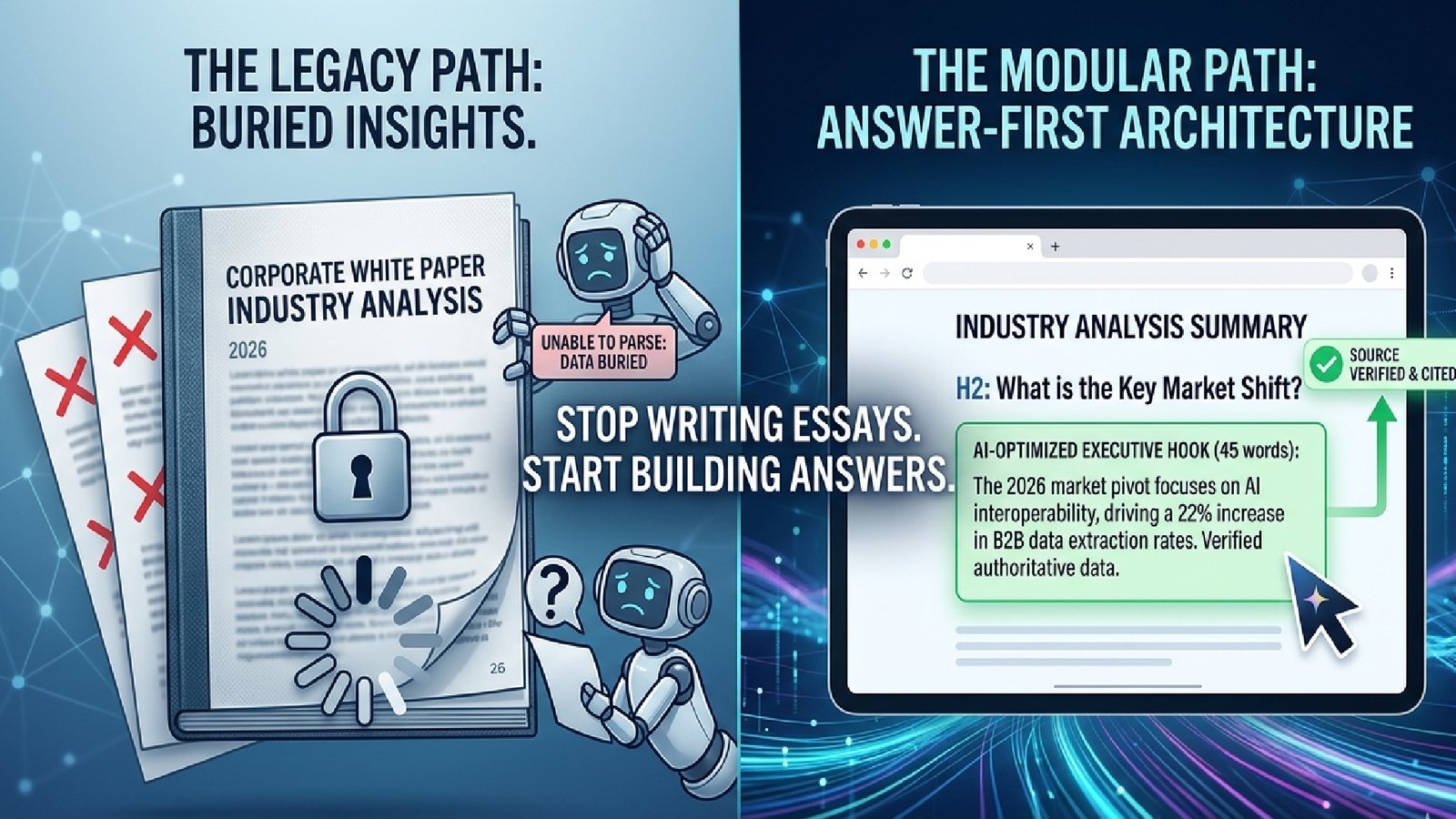
Expanding on something I touched on last week... for the past decade (longer?), the playbook for enterprise content marketing was simple: produce highly detailed white papers and exhaustive "ultimate guides" to prove your subject matter expertise. The longer the PDF, the higher the perceived value.
But as we navigate the digital environment of 2026, that strategy has officially hit a wall.
The problem isn’t that your buyers no longer value deep research. The problem is that the middleman between your data and your customer is no longer a simple search algorithm pointing to a resource link. The middleman is now an Answer Engine. And they don't value the same things. (And that has huge implications for measurement, as I'll touch on below, but will save that for another time.)
Whether a decision-maker is asking a voice assistant, querying an enterprise AI, or reading a Google AI Overview, these engines are all searching for a single thing: a concise and digestable "single source of truth." They prioritize content that delivers an authoritative, fact-dense answer instantly, typically within the first 50 to 70 words of a digital section.
If your core insights are buried on page twelve of a downloaded white paper or hidden under three paragraphs of historical industry context, the AI simply moves on to a competitor whose data is easier to extract.
To ensure your proprietary research and intellectual property are actually found and cited by modern platforms, and that you might actually be able to show your leadership some measures of marketing effectiveness, requires a substantial change. Content development needs to pivot away from creative essays and move toward an institutional framework built around immediate data delivery that highlights impact, and doesn't dwell on confirming authority.
This requires implementing an Answer-First Architecture:
Front-Load the Resolution: Treat your web properties and executive summaries as standalone micro-assets. You have to set the hook with immediate value before you can expect an AI - or a busy executive - to sit through the story. State the core thesis, the primary metric, or the strategic definition immediately in 50 words or fewer. Use the remaining pages for deep-dive nuance and methodology, not the setup.
Deconstruct White Papers into Extractable Snippets: A gated PDF is a data black box to an AI search crawler. To unlock its value, key findings from your white papers must be mirrored on high-visibility web pages in cleanly formatted, un-gated blocks that machines can index and quote.
Design for Extraction, Not Exposure: Traditional metrics track how long a user spends scrolling a page or reading a document. Answer Engine Optimization (AEO) tracks how clean your layout is for an AI crawler. If your data can't be pulled into a featured snippet or an LLM summary seamlessly, the depth of your research doesn't matter. That changes the game for web measurement and success metrics.
Here's an interesting exercise. Open your company's most recent B2B white paper, case study, or service overview - or "ultimate guide". Read the first two paragraphs out loud.
Does it define exactly what problem you solve, how you solve it, and provide the data point that proves it? Or does it start with a vague, high-level statement about "In today's fast-paced digital landscape..."?
If it’s the latter, your content is essentially invisible to the AI tools your buyers are today using to conduct their early-stage vendor research, and especially that they are quickly relying upon to shorten the process.
Structuring information for modern discovery isn't a copywriting trick; it's a structural data discipline. The brands dominating search share today aren't out-writing their competition; they are out-formatting them.
How does this thinking align with what you're seeing with your own content efforts? Start a dialogue below!
View original on LinkedInWant to discuss this further?
Our team thinks about these problems every day. Let's start a conversation.
Book a discovery call