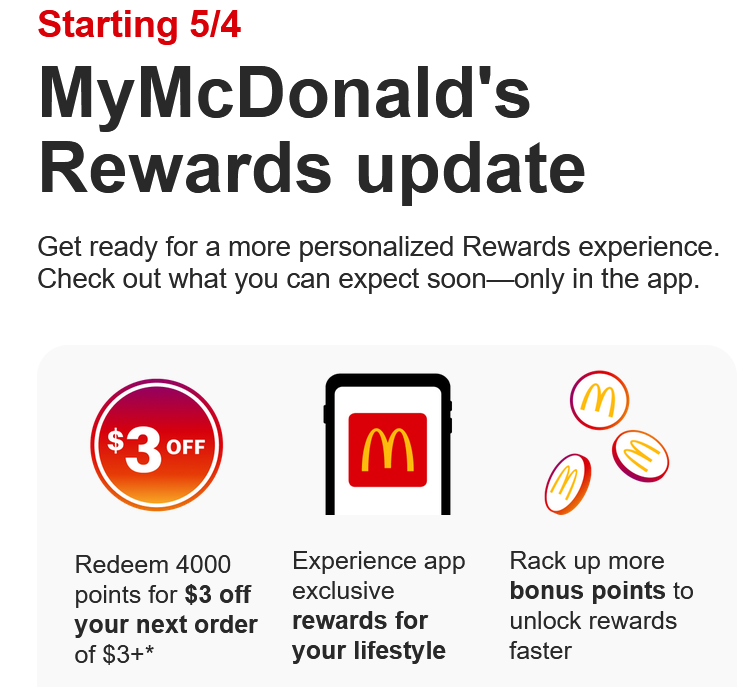
Today I received an email from McDonald's promoting its “MyMcDonald’s Rewards update” starting 5/4. The body of the email promises a “more personalized Rewards experience,” “app exclusive rewards for your lifestyle,” and “bonus points to unlock rewards faster.”
Sounds great — until you look at the details.
What’s really happening is a quiet but meaningful step-down in reward value.
Using the numbers in the email, and looking up local prices in the app, so this may have some regional variations, here is what I found, where "giveback ratio" is the value of the reward divided by the spend required to redeem the reward:
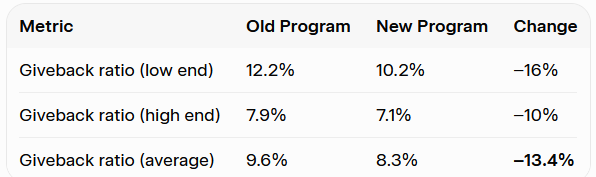
In other words: the points currency just became ~13% less valuable, while the simplest, no-loyalty-required deals look more attractive than ever.
Back in November 2023 I wrote a three-part series on the future role of rewards in restaurants. In Part 3 I said:
“How do I think the role of rewards programs in restaurants will evolve in the future?...chains like McDonald’s, Subway, Domino’s etc. that have a broad footprint, high visit frequency, and category leadership, and may even have developed a consumer habit, like Starbucks... Expect these to continue to step down the value of rewards and even phase them out over time. Shifting from spend-based to visit-based rewards may be a first move. Members may grumble but will quickly fall back into their visit routines. Apps will be used as a platform that delivers increasingly tailored offers and promotions based on individual purchase history.
McDonald’s is now the third of those four major brands to do exactly that. Starbucks had a well-publicized recent revamp. Domino’s made adjustments earlier. Subway has been floundering amid store closures and has changed their program but doesn't seem to have settled on a new approach. So the pattern is clear: the biggest players with the broadest consumer penetration are deliberately making points less generous.
Key insights and takeaways
Framing matters more than facts. McDonald’s is selling this as “personalized” and “lifestyle” focused, even though the math shows the program delivers lower value to members. The language is designed to soften the devaluation and keep members engaged in the app.
Deals are quietly becoming the new loyalty currency for QSR. The rich, simple, no-points-required offers in the Deals tab are more compelling than point redemptions for anyone spending $15+. This suggests the long-term strategy is moving away from a complex points bank and toward targeted, data-driven promotions that don’t require members to track balances.
Consumers adapt faster than the industry expects. After Starbucks’ changes, the loudest complaints came from loyalty marketers - not everyday customers. Habit and convenience win. People keep coming back even as programs change.
The replacement strategy is still unclear. McDonald’s (and peers) are devaluing points without fully revealing what comes next besides vague talk about personalization. The app itself has become a powerful data and promotion engine, but the “what” of the new rewards experience remains hazy beyond “personalized” and “exclusive.” That's not enough to drive long-term engagement.
What competitors should consider doing
Stop competing on points generosity. The era of generous, spend-based rewards as a differentiator is ending for high-frequency QSR leaders. That has been a recent theme among many of the articles I have been reading.
Double down on true personalization using purchase history. Use the data you already have to deliver relevant offers at the right moment rather than hoping points alone drive frequency. But temper your expectations about how much incremental spend is possible to achieve, and over what timeframe.
Make deals stackable or hybrid. Obviously this requires rigorous financial modeling, but it provides a point of competitive differentiation. Rewards are supposed to be just that, not additional deals. Test simple $ off or % off that can combine with (or replace) points so the value feels additive, not zero-sum.
Shift to visit- or occasion-based rewards. Move away from pure spend thresholds toward “your 4th visit this month” or “next time you order breakfast” logic - it’s cheaper to deliver and reinforces habit, utilizing an element of gamification to create urgency.
Be transparent internally. Track your own giveback ratio over time. If it’s trending down, own the strategy publicly instead of disguising it as “personalization” or "enhanced rewards".
The big chains are voting with their math, and not hiding it: high-value points programs are becoming financially unsustainable for category leaders, and internally they may have recognized that optimizing use of the app as a communications channel can drive as much profitable, incremental spend as a points program. The question now is what they build next as an engagement mechanism, and whether the rest of the industry will learn from the pattern or keep chasing yesterday’s loyalty model.
What do you think? Are you seeing similar quiet devaluations in your category? Have you noticed consumers caring less about points value than we in loyalty marketing assume? Drop a comment or connect — always happy to discuss where restaurant rewards are headed next.
View original on LinkedInWant to discuss this further?
Our team thinks about these problems every day. Let's start a conversation.
Book a discovery call