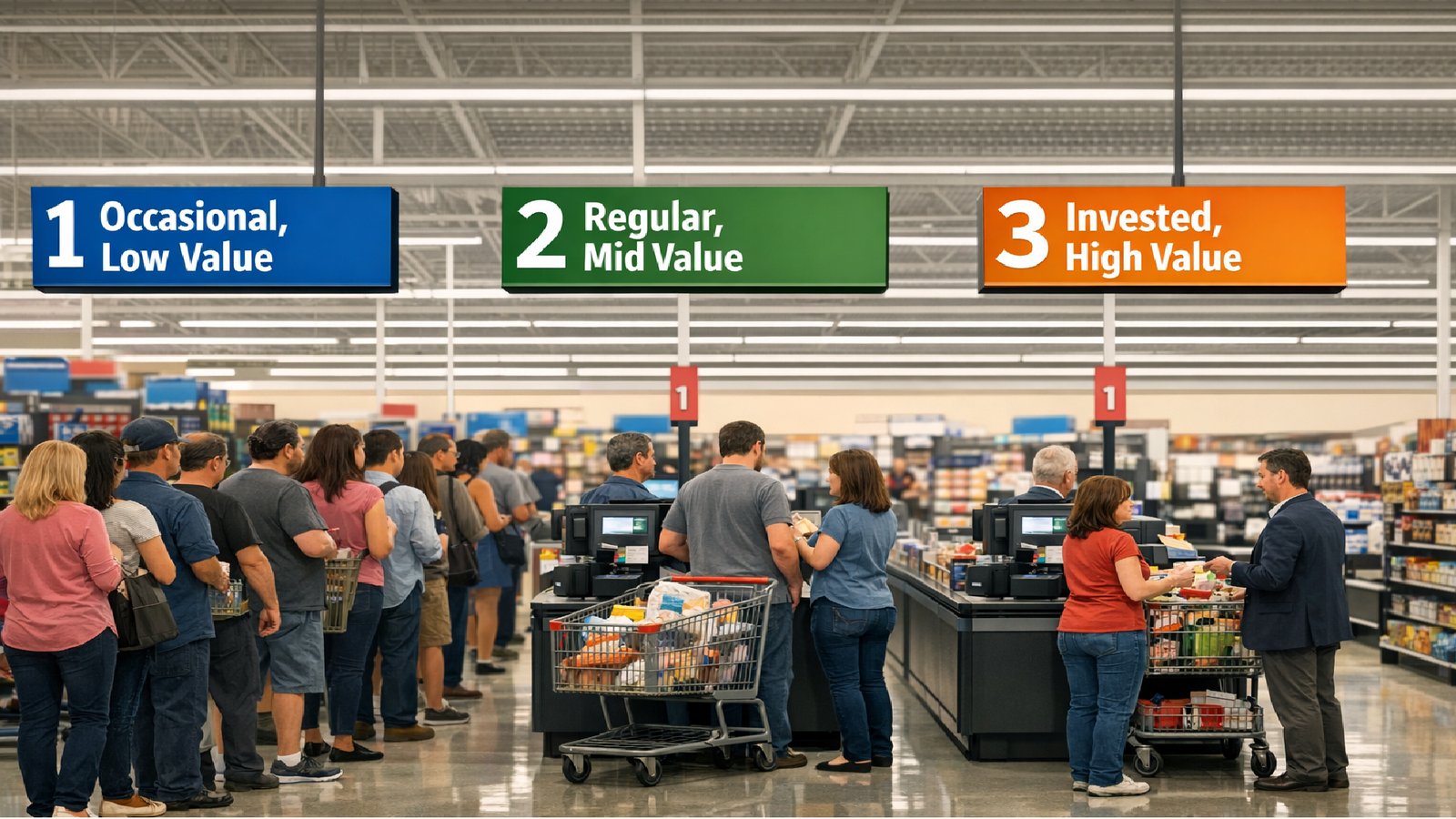
The recent relaunch of Michaels Stores Rewards signals a broader shift in how specialty retailers are, or should be, thinking about loyalty. By moving to a three-tier system (3%, 6%, and 9% back), Michaels is acknowledging a truth that many big box and restaurant brands acknowledge in theory but ignore in practice: not all consumers are on the same journey.
While segmentation is an old tool, it has rarely been baked into the actual mechanics of program design. Instead, programs are built to satisfy the "net new member" metrics desired by Wall Street. This creates a gravitational pull toward the middle: a one-size-fits-all model that focuses on casting the widest possible net. The result is a program that is often too complex for the casual shopper and too diluted for the brand enthusiast.
In specialty retail, this strategy can be particularly costly. The specialty base is naturally polarized: you have a massive cohort of occasional, need-based shoppers and a smaller, high-value core of brand enthusiasts - for Michaels, for example, this might be made up of teachers, small business owners, and hardcore hobbyists. But when the program is designed for the "average" member, it is targeted for someone who doesn't actually exist. Michaels is taking a more precise and targeted approach.
And that suggests they have recognized that the real opportunity isn't in acquisition (the vanity metric), but in segment velocity.
The program should not be a static bucket for all members; it should be a machine designed to pull the occasional shopper into the enthusiast tier, and to keep the enthusiast tier spending. By offering 9% back at the top, Michaels isn't just rewarding spend; they are creating a financial switching cost that makes it painful for a high-value customer to shop anywhere else.
This leads to a fundamental shift in how we measure success. We have to stop asking "How many people enrolled this period?" and ask "How many people are moving up the ladder?" and “Are we retaining our best customers at the same spend level?”
1. Designing for the Top, Dragging the Bottom In this model, the program is built specifically to ringfence the top 10% of customers who drive 60% of the revenue. For Michaels, the entry-tier rewards (3%) exist only to identify the casual shopper and wait for a signal. You don't over-invest in the person who buys one picture frame a year. You simply keep the lights on for them until their purchase frequency signals they are ready to climb.
2. The Switching Cost as a Strategy For a specialty retailer, the top tier should be engaged in a mutually-rewarding relationship. At 9% back, the reward becomes a margin-saver for a small business owner. It creates a "Platinum Gap" that makes a competitor's 20% off coupon look like a bad deal in comparison. Loyalty in specialty retail is about creating a fortress around your most profitable flank.
3. From Data Capture to Data Utility Once the program is designed for progression, identification at the register becomes a utility for the customer, not a chore for the brand. If the customer knows that identifying themselves is the only way to maintain their 9% advantage, they will solve the friction problem themselves.
If you are managing loyalty for a specialty brand, your strategy should move away from the "net new" obsession and toward precision recognition:
Stop Chasing the Ceiling: Don't obsess over total enrollment numbers. In a saturated market, your best growth comes from the customers you already have. Use your budget to deepen the relationship with the top 10% rather than buying more names for the bottom 10%.
Plug the Leaky Bucket. Focus on avoiding down-migration among value segments. If enrollment is up but Tier 1 is shrinking, you’ve got a leaky bucket.
Reward Identification with Utility: Give your top tiers more than just points. Give them early access to high-demand inventory, professional-grade discounts, or dedicated service lines.
In specialty retail, depth beats breadth every time. Michaels is showing that the future of loyalty isn't about how many people you can sign up; it is about how well you can protect and reward the people who actually power your business.
Does your loyalty program treat a once-yearly shopper the same as a once-weekly power user? Tell us about your approach and discuss the risks of flat-rate loyalty in the comments.
View original on LinkedInWant to discuss this further?
Our team thinks about these problems every day. Let's start a conversation.
Book a discovery call