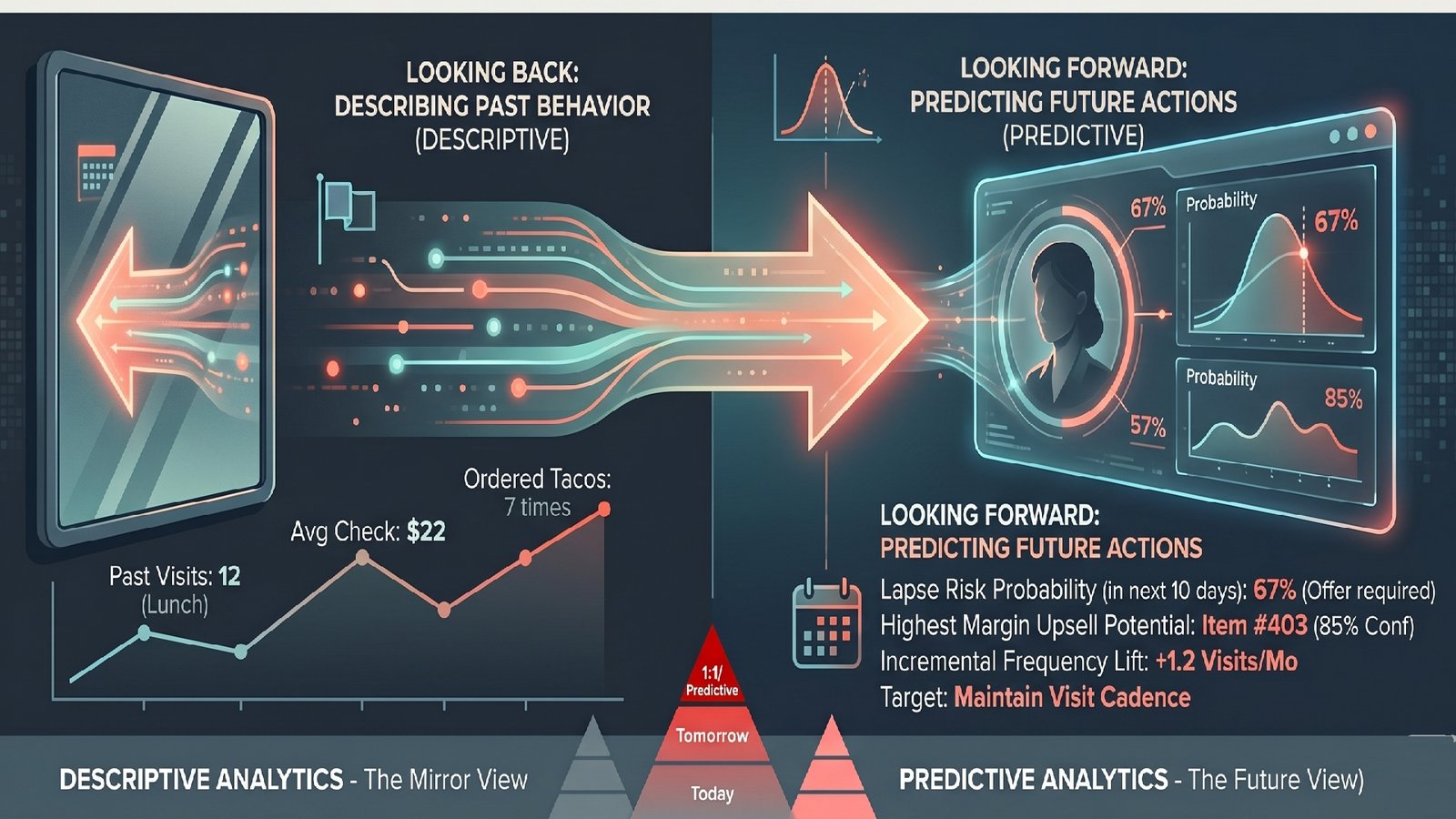
I’ve written extensively about the "upside" of personalization, and more specifically, why the ROI often fails to materialize (see here, here and here). As we navigate 2026, many executives are still chasing the 15% lift promised by the consultants years ago, yet implementation remains a quagmire of tech hurdles and creative exhaustion.
A well-done recent industry study from Restaurant Loyalty Specialists, the Restaurant Loyalty Frontier, confirms that personalization remains the North Star for marketing execs looking to leverage the data their programs are collecting. However, reading through the aspirations of these leaders revealed a concerning trend:
We are still trying to solve tomorrow’s problems with yesterday’s logic.
One phrase that kept surfacing in the study was "product propensity messaging." The logic sounds intuitive: “Let’s sell sushi to the people who love sushi” or “I’m going to sell you what I know you like.”
But here’s the problem: That isn't personalization; it’s just digital shadowing.
When we focus solely on past behavior, we aren't being relevant, we are being redundant. If I buy a taco every Tuesday, I don't need a marketing email to tell me I like tacos. By focusing only on what a customer has done, we miss the opportunity to influence what they might do next. This "mirror-view" marketing often fails to drive incremental revenue; instead, it often just subsidizes the visits the customer was going to make anyway, or is ignored.
This isn't a new struggle. A decade ago, I worked with a national casual dining brand to leverage their loyalty database and revolutionize their messaging. We identified 47 behavioral dimensions, things like Lunchtime Visitor, Solo Diner, Orders Appetizers, etc. We flagged every record in the loyalty database, convinced we had found the Holy Grail of relevance and could use individual dimensions to drive campaign planning.
Then the analysts stepped in.
The first thing they did was a factor analysis to see what was actually driving the business. It was a reality check: of those 47 dimensions we had identified with such excitement, only 18 actually mattered. Most were mathematically redundant, either highly correlated with one another or lacking the data density to be actionable across the total member base.
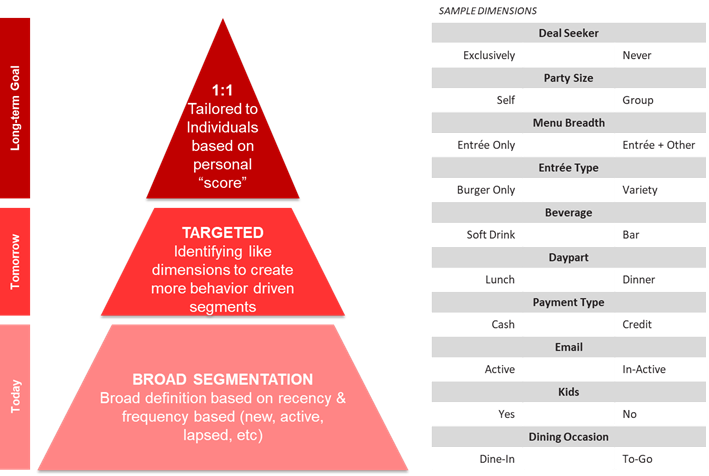
We learned a hard truth: Complexity does not equal Closeness. Just because you can flag a behavior doesn't mean that behavior is a lever you can pull to drive an extra visit. This eventually led us back to a staged implementation: starting with a manageable 7-segment grouping and ultimately moving toward 1:1 based on individual predictive scores. It was progress, but it wasn't the overnight game-changer we anticipated.
Today, the industry is still obsessed with these simple "flags." We talk about "identifying like dimensions" to create segments, but that is still Descriptive Analytics that tells you who they were, not who they will be.
The real value lies in predictive individual scoring, not as often discussed as "personalization". Instead of labeling a guest as a "Taco Lover" (descriptive), predictive modeling asks: "What is the probability this guest will miss their expected visit next week, and which specific offer will maintain or increase their frequency?" (predictive).
Predictive analytics allows us to move past broad segmentation and into a world where we personalize based on shifting consumer behaviors, rather than just reinforcing existing habits.
We can then anticipate a lapse in frequency before it happens, for example, intervening before a guest chooses a competitor, or suggesting a higher-margin menu offering with the statistical confidence that it will be selected. This moves the needle on margin and incrementality, not just vanity engagement metrics.
As you look at your strategy for the back half of 2026, consider where you sit on the maturity curve. Most brands are still stuck in the "Today" or "Tomorrow" phases of the pyramid below, mistaking "Targeted" for "1:1."
Key Takeaways for the C-Suite:
Relevance ≠ Redundancy: If your messaging only tells customers what they already know about themselves, it isn't driving incremental revenue.
Data Density is Your Guardrail: You don't need 50 flags; you need five that actually correlate with frequency and spend. Don't build campaigns for segments that are too small to move the needle.
Predict the Missed Visit, Don't Just Report It: True 1:1 personalization is powered by individual propensity scores that trigger before a behavior changes.
The Analyst is your Reality Check: Use your data team to validate if your personalized campaigns are actually driving incremental visits and spend or just capturing the habitual spend you would have gotten anyway.
The shift from tracking what happened to predicting what will happen is the difference between being a reactive marketer and a proactive growth driver. Are you still building your strategy around 'look-back' dimensions, or have you moved toward individual predictive scoring? I’d love to hear how your team is navigating the gap between descriptive data and incremental revenue in the comments.
View original on LinkedInWant to discuss this further?
Our team thinks about these problems every day. Let's start a conversation.
Book a discovery call