In the previous posts in this series (here, here and here), we’ve looked at the selection bias that skews your starting data and the mathematical ceiling that caps a loyalty program’s long-term growth. But if the 20% lift is more of a reach in reality than the experts think, why does it continue to be so commonly cited as the expected result?
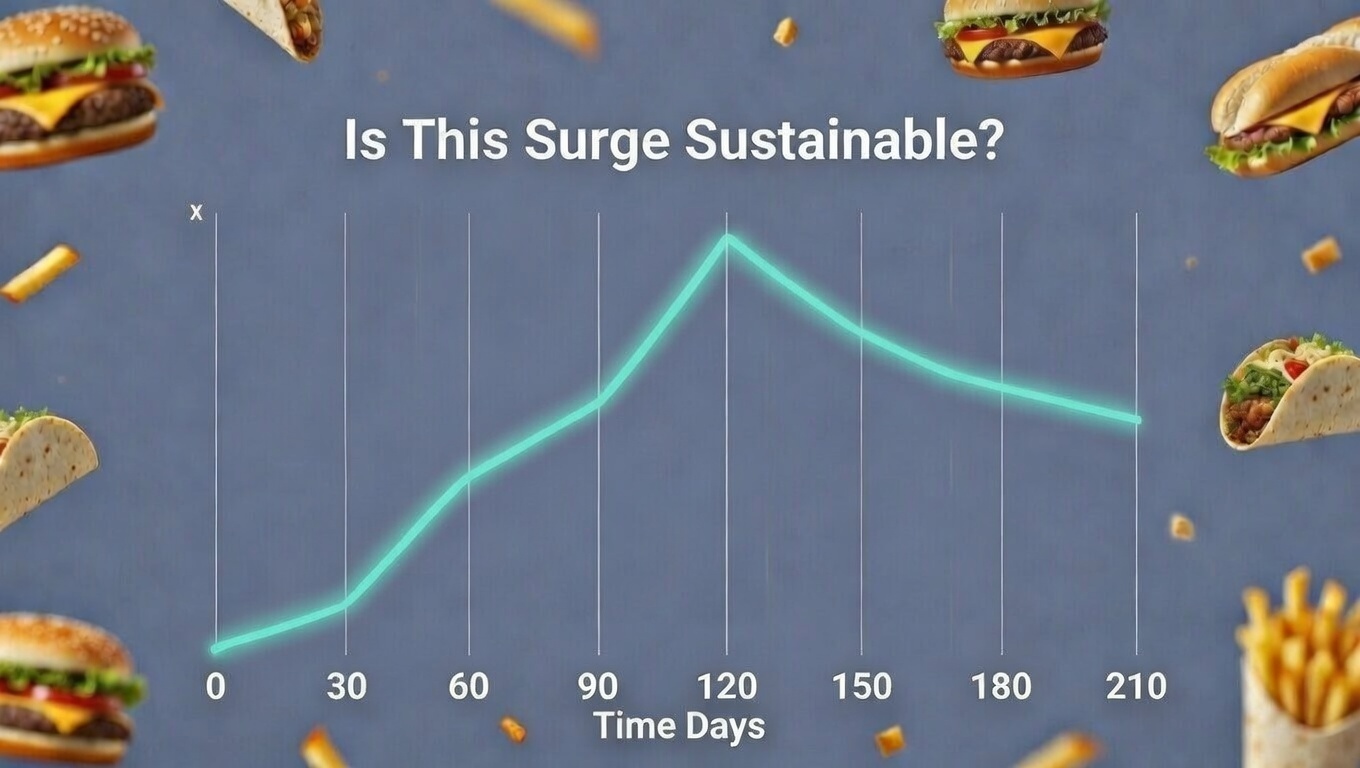
The answer lies in a phenomenon I call the 120-Day Sugar High. When a major restaurant brand launches a loyalty program, the initial results can be spectacular. Same-store sales (SSS) spike, digital mix explodes, and frequency metrics for the “new member" cohort look like a hockey stick. It feels like a fundamental shift in consumer behavior. But if you look across multiple program launches, those results almost never represent a new baseline, as they quickly fade.
I analyzed the SSS trajectory of a dozen restaurant brands that have launched programs since 2021, and for which sufficient data was publicly available, indexing their performance from "Quarter 0" – the year/quarter of their program launch. There is a lot noise in the data, and different brands with different marketplace challenges (Cracker Barrel comes to mind, for instance…), but a broad pattern does reveal itself, as is visible in the chart below:
The Spike (Month 1-4): At some point in this period, almost all brands exhibit a visible upward trend in SSS, with a couple of exceptions. This is often driven by aggressive launch marketing and "welcome" rewards that effectively pull forward demand.
The Reversion (Month 6-12): Again, with a couple of exceptions (hello, Dutch Bros Coffee!), a steady decline back toward the brand’s original, pre-program trajectory is noticeable.
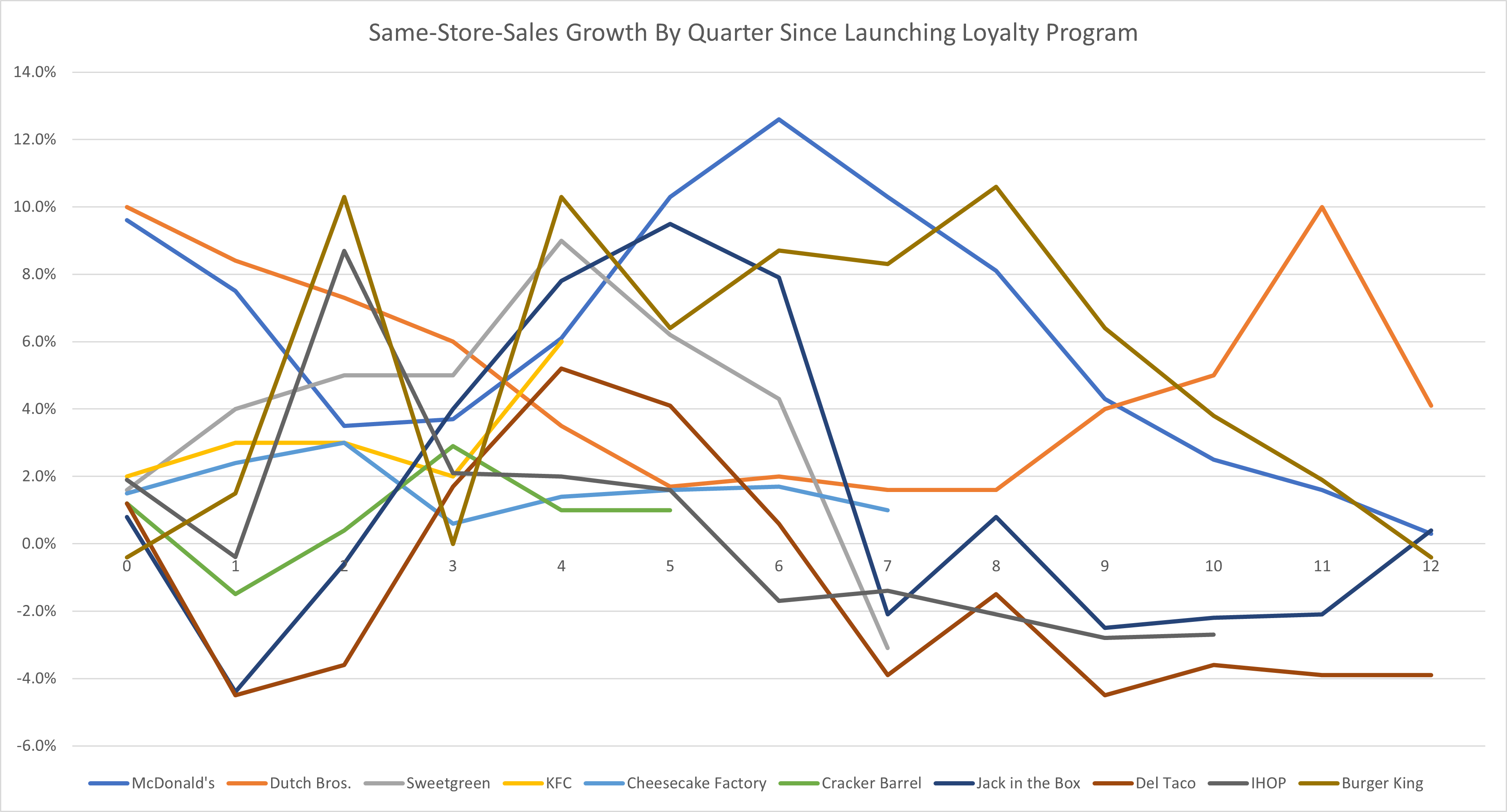
The initial lift that may be observed is artificial - once the enrollment reward is eaten and the novelty of the points program fades, the customer reverts to their pre-existing tendencies. They aren't visiting a specific restaurant more often over a longer period; they were just temporarily shifting their behavior to try to earn a reward or excited by the novelty of the brand's app.
Rewards vs. No Rewards: Spot the Difference The most damning evidence against the sustained “member lift miracle” is a comparison of brands with rewards programs versus those without. The chart below includes publicly reported data for about 45 restaurant brands with and without loyalty programs; the data is shifted if a new program was launched, and I excluded outliers like Chili's and Texas Roadhouse that are outperforming their peers for different reasons. The takeaway: when you overlay year-over-year SSS changes for those brands with and without programs, the lines are nearly identical.
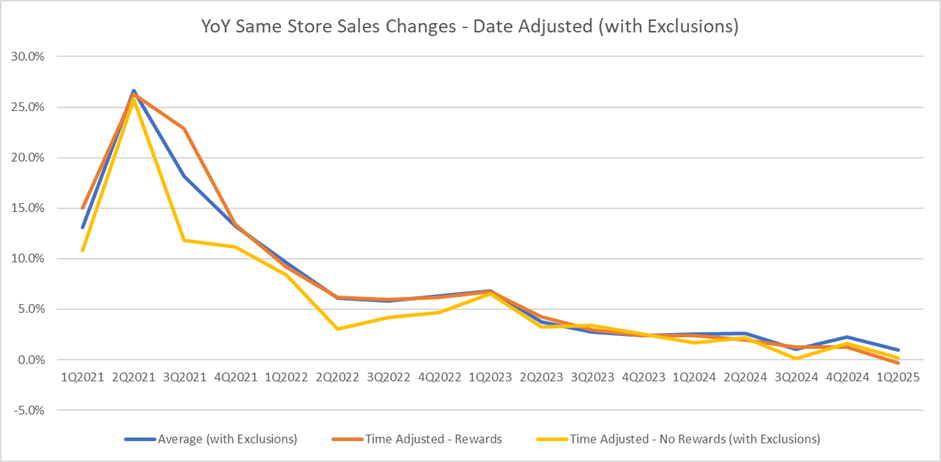
If loyalty programs in their current form were truly differentiators, we would see a massive, permanent decoupling with the orange line running consistently above the yellow line. Instead, we see that all brands, regardless of their level of giveback, tend to move in lockstep with broader market forces like inflation, consumer confidence, and food-away-from-home trends. (One I will be interested to watch is Subway – their B4G1F Sub Club offer, recently ended, was so much richer than any other program out there.)
Smart Interpretation: A loyalty launch is a Marketing Event, but a sustainable baseline is an Engagement Event, whether that runs through the product experience or other mechanisms.
If your same-store sales growth isn't structurally higher 24 months post-launch than it was pre-launch, your loyalty program hasn't changed much behavior, it has just digitized your existing fans and added a cost layer to their transactions.
Now, there can be a benefit to that, and therein lies the opportunity, to be discussed tomorrow in the final entry in this series.
In the meantime, the "120-Day Sugar High" is how we get fooled into believing in the 2.6x lift McDonald's has claimed is also possible for our brand – and sustainable. We take the short-term spike of our most excited fans and project it across our entire user base for the next five years. That is a recipe for a massive capital allocation error.
Agree or disagree? Would love to hear why.
Next Step: Post V—The Action Plan. We’ve spent four days discussing whether the lifts promised by industry rules of thumb are mathematically possible. On Friday, I’ll outline the specific steps to take in 2026 to move beyond "earn & burn" and into "utility & enhanced experience."
View original on LinkedInWant to discuss this further?
Our team thinks about these problems every day. Let's start a conversation.
Book a discovery call