How do you validate your loyalty program when 5 million new members and 21 million active members can’t stop transaction counts from falling?
In yesterday’s post, I questioned the logic behind the "150% frequency lift" often touted by QSR executives. I argued that the McDonald's 10.5x-->26x visits pre/post-enrollment claim is likely a byproduct of selection bias – where your best customers join first – and a "tracking fog" that makes anonymous visitors appear less frequent than they actually are.
Today, I want to stress test my theory.
If a loyalty program can truly double a customer’s frequency post-enrollment, we should see the proof in the most mature, transparent, and digitally advanced program in the industry: Chipotle Mexican Grill.
Chipotle has a massive database with approximately 50 million members, of which 21 million are 6-month active members, and nearly 40% of their sales are digital, with 90% of those from loyalty members. If the "2.6x lift" exists anywhere, it should be found here. But as I’ll discuss below, recent data tells a story of a consumption ceiling that even the best AI can't break through.
In 2025, Chipotle’s loyalty program was continuing on a growth trajectory: it is estimated that they successfully added between 5 and 8 million new members, a very healthy increase of 12-17%, amazing for a program that’s been in the market since 2019. In a world where enrollment drives a massive frequency multiplier, this should have been a transaction-growth machine. Instead, Chipotle’s total transaction counts fell by nearly 3% for the year.
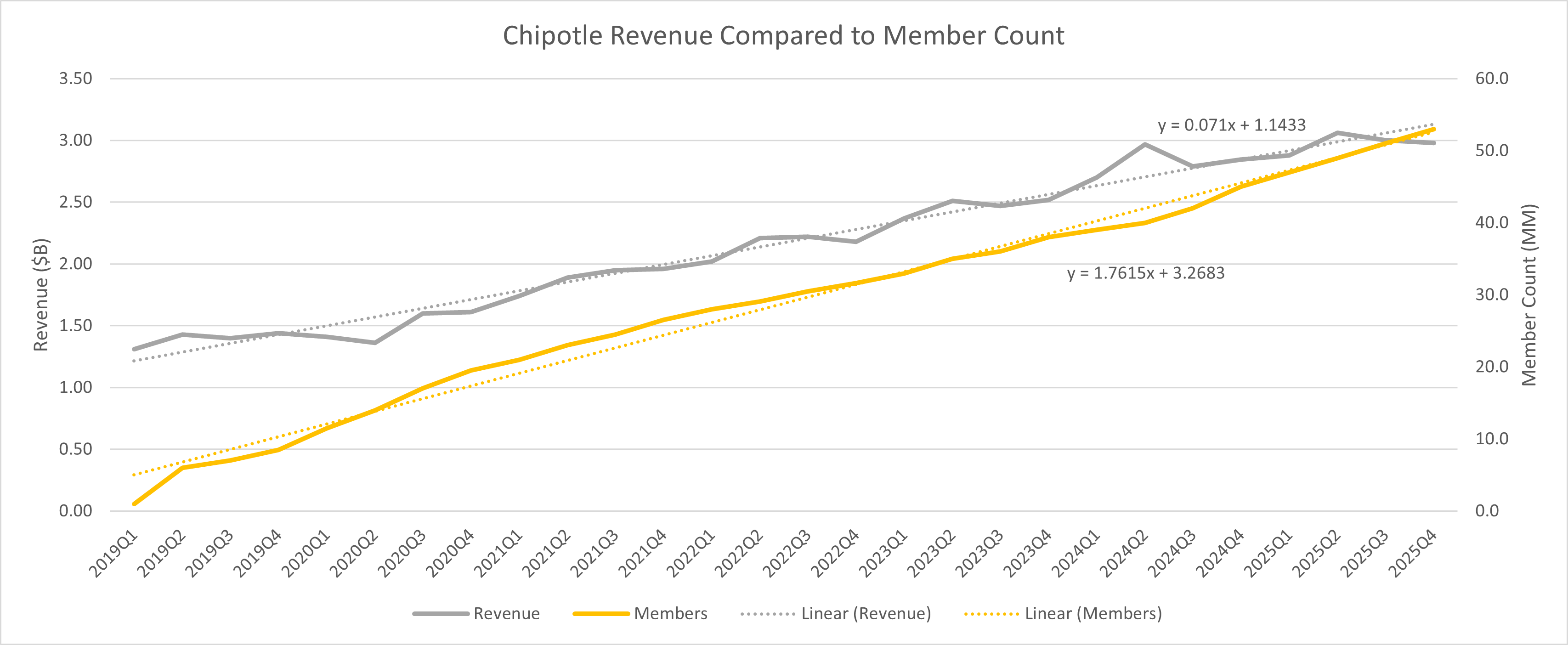
Stop and consider that friction for a moment. If 30-40% of your transactions come from loyalty members who are supposedly visiting twice as often, how can total transactions decline while the member base grows? The math doesn’t work. And it reveals a fundamental truth that some loyalty consultants prefer to ignore: database growth does not equal behavioral growth.
Chipotle isn't failing – not with revenue growth and earnings exceeding expectations – but they are hitting what I call the consumption ceiling. There is a physiological and economic limit to how much fast-casual food a human being can consume in a week. Loyalty programs are masterful at tagging your core fans, but they are not magic. And they cannot gamify a person into eating two lunches.
Let’s look at the math. (I know, this is not precise, since I don't have access to actual transaction data, but it's conceptually and directionally correct...) In 2025, Chipotle reported total revenue of $11.9 billion. Since launching their rewards program in 2019, they have grown revenue by approximately $6.3 billion.
Where did that $6.3 billion come from?
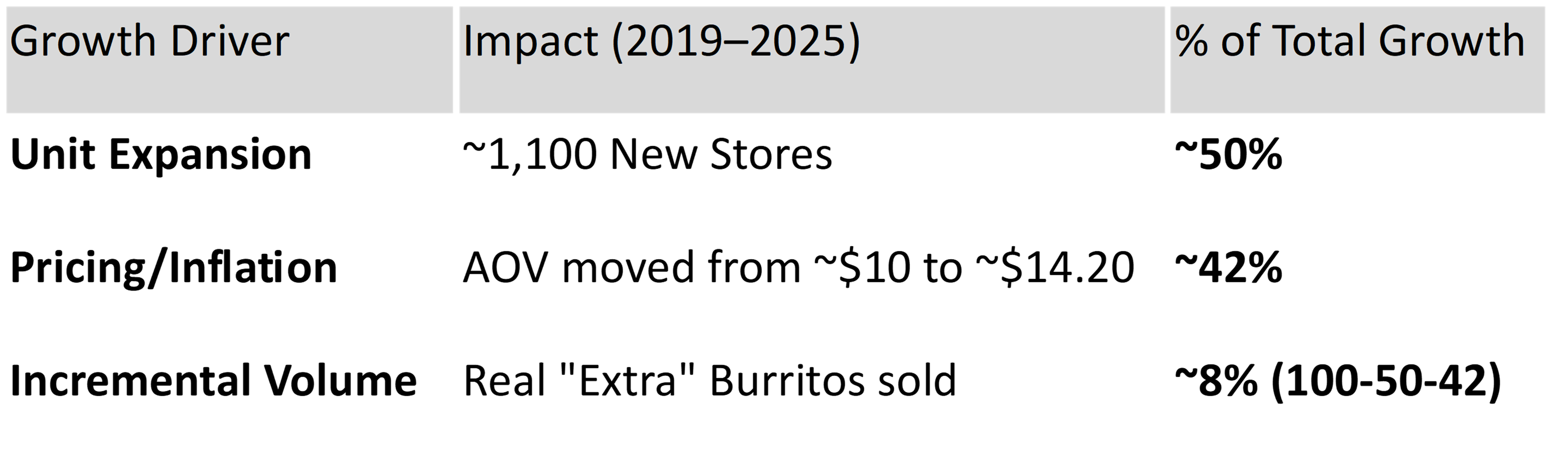
If this is true, 8% Incremental Volume is the absolute maximum credit we can give to the loyalty program after we account for more measurable factors – and that’s assuming none of that growth came from non-members (which is unlikely).
So if the "2.6x loyalty lift" were real, the math breaks.
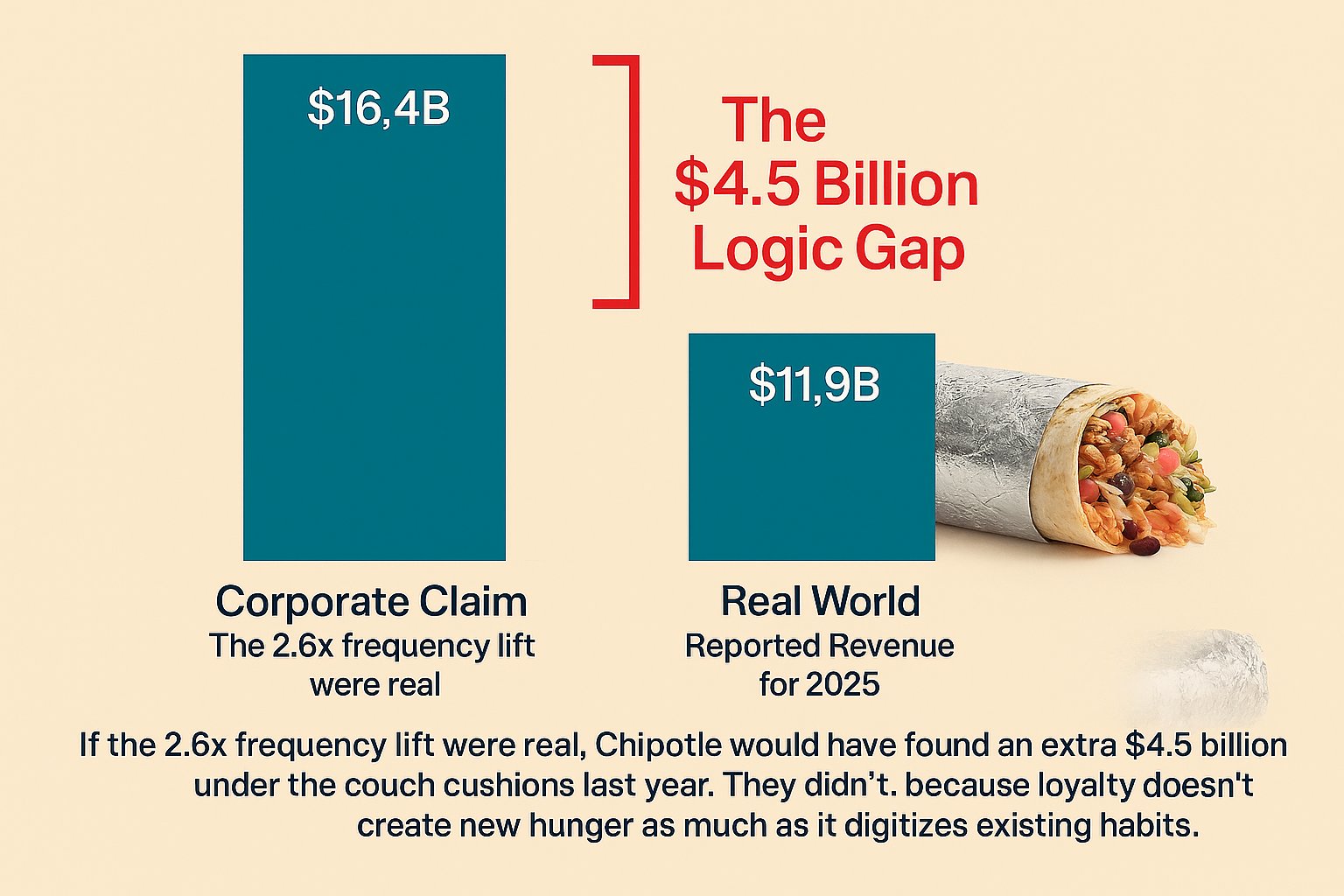
For 5-8 million new members to visit 2.6x more often than the year before, not to mention existing members continuing to visit at that rate, there would have to be a massive total revenue explosion, and Chipotle’s non-member walk-in business would have to be crowded out at the same time. Specifically, for the 2.6x claim to be true, Chipotle’s walk-in traffic would have to be down 60% to keep the total revenue at $11.9B. And that didn’t happen. So the loyalty lift can’t be anywhere near 2.6x. And suddenly 8% looks more reasonable. As I also suggested earlier might be closer to the truth for McDonald’s.
Crucially, because members primarily use the app, the most expensive way to order due to digital markups and service fees, their higher spend may be mis-categorized as loyalty lift. In reality, it’s a channel markup. The guest isn't buying more food because they love the points; they are just paying a premium for the convenience of the interface.
Chipotle’s program remains a massive success, but not necessarily for the reasons often cited on earnings calls. It hasn't solved the problem of shrinking walk-in traffic, and it hasn't broken the ceiling of human appetite. What it has done is create a vital defensive moat. By focusing on their most valuable 30%, a group that is affluent, young, and so far, generally price-inelastic, they can raise prices and ward off competitors without losing their core.
But we must set our expectations correctly and stop treating these programs like offensive growth engines that can override the baseline of human behavior over a sustained period of time. Once you have onboarded your core fans, further growth becomes harder.
Smart Interpretation: If your brand has negative same-store-sales and declining transactions during a year of significant loyalty enrollment, your program has hit a consumption ceiling. You aren't selling that many more burritos; you’re just putting a name against the ones that are already being sold.
Now that we’ve seen the logic gap in the results of the industry's biggest brand, how do you measure your own? Tomorrow, I’ll share the Incremental Yield Index—a simple equation you can use to strip away the noise of price hikes and new stores to see what your loyalty program is actually doing to consumer behavior.
View original on LinkedInWant to discuss this further?
Our team thinks about these problems every day. Let's start a conversation.
Book a discovery call