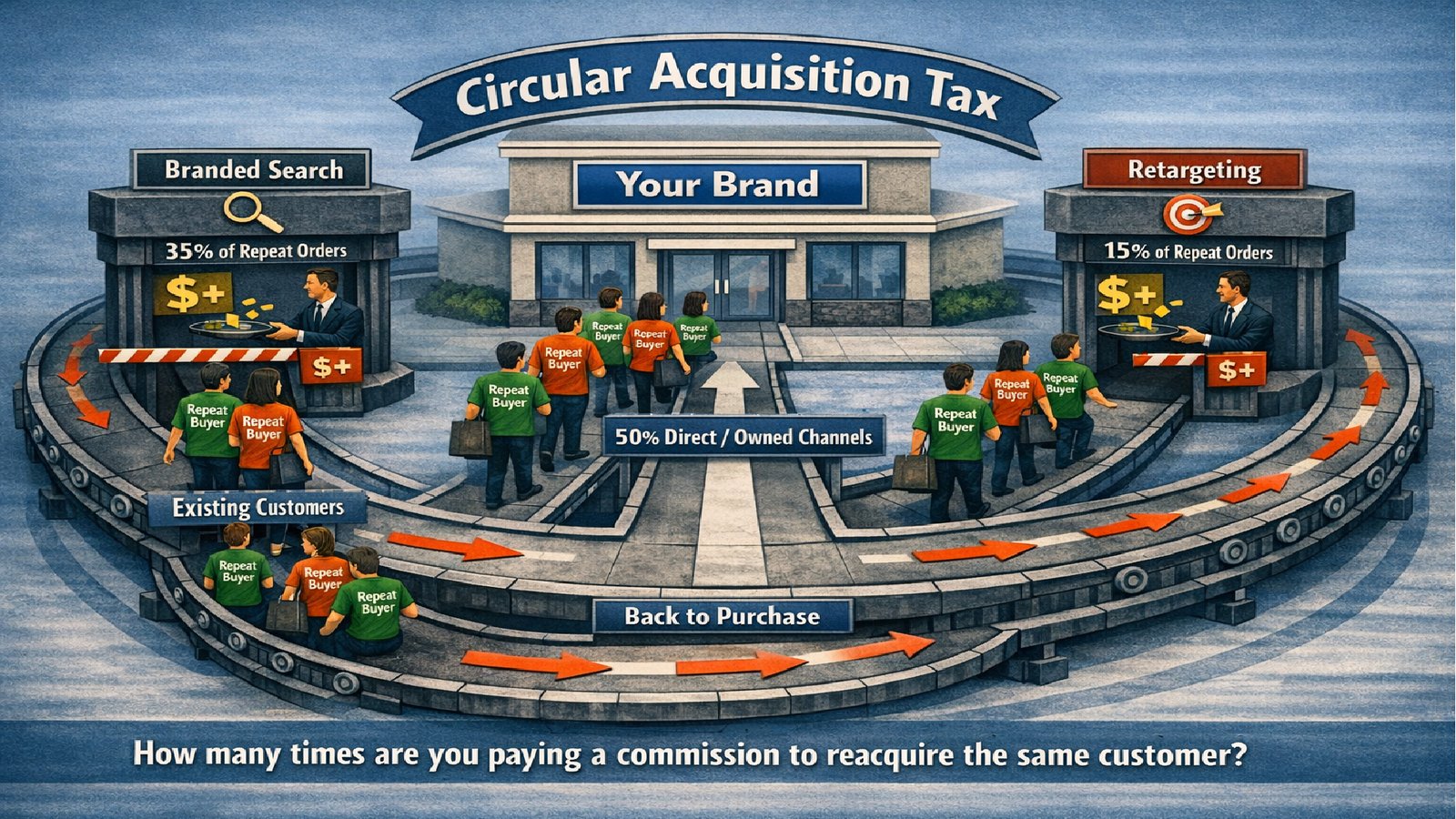
As we discussed in the previous post, companies like Wayfair are stuck paying a "precision premium" for a net that is actually quite wide. But the misfire goes deeper: a massive chunk of their $1.4 billion acquisition spend isn't even finding net new customers. It's re-buying the ones they already won.
The Misfire: "Acquiring" the Already-Won Generally, marketing analytics dashboards treat a conversion as a win or conquest, regardless of the customer's history. But for a mature e-tailer, like Wayfair, repeat customers can drive up to 80% of total orders. If you are still heavily weighted toward branded search (bidding on your own name) and dynamic retargeting, you are paying a recurring tax to the platforms just to let your own customers back through the front door.
Here’s an example of how it could play out:
Year 1: You pay $50 to acquire a new customer via a generic category-focused search term. For Wayfair, for example, that might be something like “table lamps”.
Year 2: That customer wants to buy something that Wayfair offers again, like a rug, but they’ve essentially ignored email outreach while they were out of the buying process. So to make it easy for themselves, they type “wayfair” into Google, to whom you pay $15 for the branded ad click.
Year 3: Back in the market again for a patio set, and this time the consumer clicks through an email from Wayfair but gets distracted before buying. Later they see a retargeting ad on Instagram and click through to complete the purchase. Wayfair pays another $20 to convert them – yet again.
Your dashboard shows three distinct and efficient conversions – each individually falling within your target CAC. But your effective CAC is now $85, and that may be higher than your target ceiling. You haven't grown your customer base because it’s all the same customer; you've just shared your margins with Alphabet and Meta.
The Winner: Airbnb The ultimate example of breaking this cycle is Airbnb. In a move that shocked the industry in 2021, Airbnb slashed its performance marketing spend by 28% and shifted the focus to brand-building. (See below for a discussion of how they did this.)
The result? Over 90% of their traffic now comes directly to them or through unpaid channels. By the time someone wants to book a stay, they don't go to a search engine and click an ad; they go straight to the Airbnb app. They traded a high Effective CPM for a permanent owned audience. They proved that in today’s environment, the best way to lower your CAC is to stop buying the same person twice.
The "Circular Acquisition Tax" is a symptom of brand anonymity - whether real or imagined for comfort. If your customers only find you when they see an ad, you don't own the relationship—the platform does.
How You Can Win in 2026:
Start by accepting that acquisition has become a subscription service unless you change the game. In the old world (1990s-2010s), you bought a customer once, and then they were yours. In the 2026 digital landscape, because of how platforms like Google and Meta work, if you don't have strong brand preference, you are forced to "re-buy" that same customer every single time they enter into a need-state for your category.
Understand the realities of the Circular Acquisition Tax:
It is Mandatory (unless you change your strategy).
It is Extractive (it takes margin without adding value).
It is Inefficient (the more you grow, the more you pay).
To repeal this tax on the bottom line, do this instead:
Segment Your CAC by Identity: Split your reporting into New-to-File CAC and Re-Acquisition Cost. If your performance budget is more than 20% re-acquisition, you have a brand preference problem, not a targeting problem.
The Branded Search Blackout: Periodically turn off your branded search ads. If your total orders don't drop, you were paying for clicks you would have gotten for free. But that’s the point of the test. The old rule was that you could capture 80-90% of branded searches with organic. But in the new world, many in the industry have discounted that number, and the current belief is that even if you may capture some percentage of that organically, you might still lose a significant portion of your most valuable, high-intent traffic to competitors.
Invest in the Destination: Follow the Airbnb/ASOS model. Move the waste from your wide-net performance ads into making your site/app the default choice for your category.
Acquisition should be a one-time event, not a subscription service. Manage your waste, calculate your Effective CAC, and stop paying a finder's fee for customers who already know your name.
Agree or disagree? Start a discussion below.
The Airbnb Blueprint: How They Replaced Performance with Preference
1. The "Product-as-Marketing" Pivot
Airbnb stopped using ads to sell "a place to stay" and started using product innovation to create new use cases. Instead of bidding on expensive keywords like "Cabo Vacation Rentals" where they had to compete with VRBO, they built the "I’m Flexible" button. By suggesting destinations based on the vibe or experience rather than a specific location, they moved the user’s intent from a Google Search Bar into the Airbnb App. This feature was used over 800 million times in 2021 alone. It effectively bypassed the paid search tax by delivering such value for the customer that they came back directly at scale without needing to search on a third-party platform.
2. Trading Performance for PR (Earned Media)
CEO Brian Chesky famously stated that PR is Airbnb's most important channel. They stopped paying for impressions and started creating "Cultural Moments." They shifted their media mix toward high-quality, cinematic video storytelling that aired on TV and social media. Instead of a "Click Here" call to action, the goal was to reinforce the category of hosting.
PR Stunts that Earned Reach: From the Barbie Dreamhouse in Malibu to a night in the Van Gogh Museum, they created physical experiences designed specifically to go viral.
The Math: This earned billions of free impressions. By the time they cut their performance budget by 28%, their brand awareness was so high that 90% of their traffic was direct or organic.
3. Radical Identity & Community Focus
While Wayfair and others were stuck in the circular acquisition loop, Airbnb doubled down on direct relationships.
Verified Identities: They built a database of over 200 million verified identities. By knowing exactly who their customers and hosts were, they could use owned channels (email, push notifications, in-app) more effectively to drive retention.
Host Recruitment: They shifted their remaining performance dollars toward recruiting supply (Hosts) rather than demand (Guests). They realized that if they had the most unique inventory, guests would find them organically. They stopped paying for the click and started paying to create the category.
The Prescriptive takeaway for 2026:
If you want to pull off a move like Airbnb, first you have to have a highly involved category, but otherwise you have to stop asking "How do I make my ads more efficient?" and start asking:
Can I solve the user’s need inside my app before they go to Google? (Product-Led Growth)
Am I doing anything worth talking about for free? (Earned Media vs. Paid Reach)
Do I actually own my audience, or am I just renting them from Meta? (First-Party Identity)
Airbnb didn't just save money; they built a destination brand. They proved that once you become the noun and the verb for your category, the "circular acquisition tax" simply disappears.
This short video linked below features Airbnb CEO Brian Chesky explaining the shift from performance marketing to brand building, illustrating the philosophy behind the circular acquisition tax we've been discussing. Interestingly, not many other brands have pulled this off effectively since Airbnb went down this path.
The "Power of Brand" over Performance Marketing
View original on LinkedInWant to discuss this further?
Our team thinks about these problems every day. Let's start a conversation.
Book a discovery call