In our earlier posts (here, here and here), we identified the precision paradox (paying more for wide nets) and the circular acquisition tax (re-buying your own customers). But here is the hard truth: Most CMOs can’t repeal this tax because their data is too fragmented to see it.
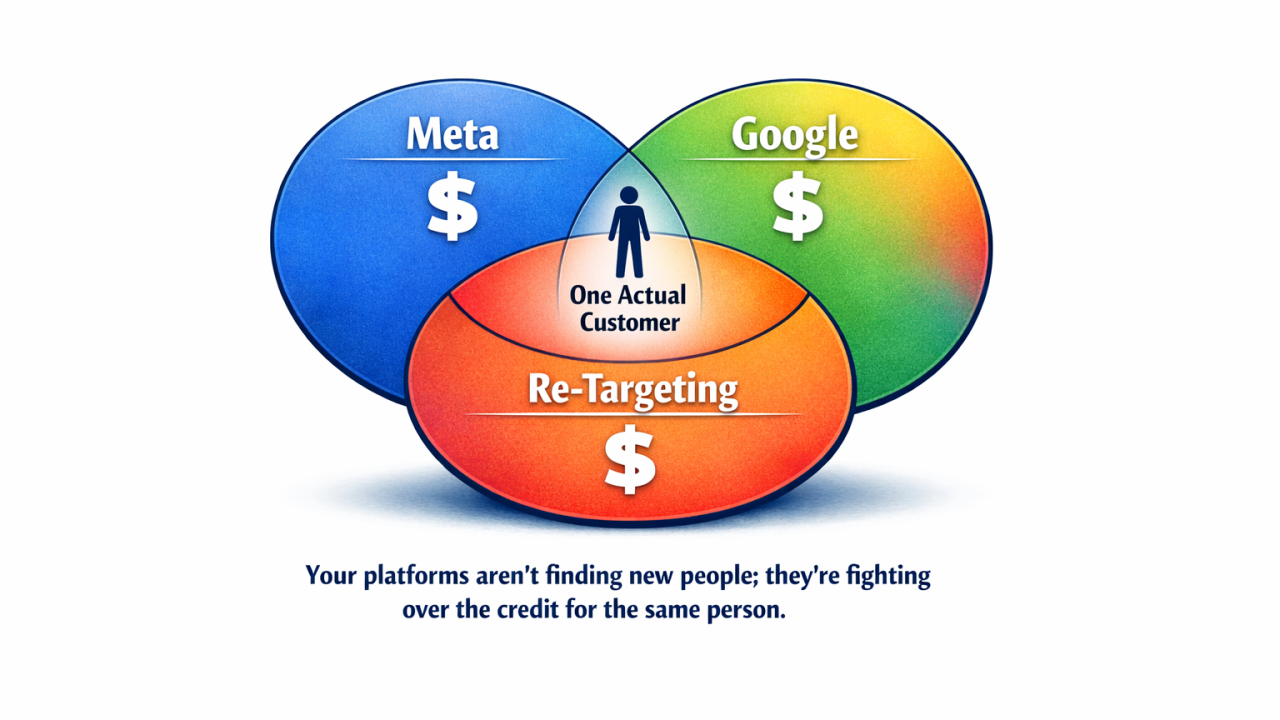
When your Meta dashboard says "100 New Customers," and your Google Search says "50 New Customers," but your Shopify only shows "110 Total Orders," you are suffering from an attribution illusion. You aren't just over-counting - you are being billed for finding the same person by three different gatekeepers, each taking 100% of the credit for a customer that was already yours.
In 2026, the average consumer has five or more digital identifiers (emails, device IDs, app logins, etc.). Without identity resolution, your analytics may see one person as five separate prospects.
The Misfire: You spend money to "prospect" an email address that already exists in your loyalty program under a different device ID.
The Result: You pay a $40 Acquisition fee for someone who should have been reached via a $0.01 push notification.
The Solution: The 4-Step Identity Audit To win in 2026, you don’t need more ads; you need a single source of truth. Here is how to audit your way out of the tax:
Deduplicate the Prospect Pool: Use an Identity Resolution tool (like a warehouse-native CDP – a system that sits directly on your own data, so you aren't sending more files back to the big tech platforms) to match your targeting lists against your existing customer list. If more than 10% of your new prospects are actually existing customers, you are literally paying to bid against yourself.
Calculate the Re-Acquisition Ratio: Segment your spend. What percentage of your performance budget over the past three months is spent on people who have bought in the last 12 months? If that number is rising while your total revenue is flat (aka, "The Wayfair Curve"), you are trapped in a circular loop.
Implement The Suppression Mandate: Active customers should be 100% suppressed from all high-cost prospecting campaigns. If your precision AI can’t exclude someone who bought from you yesterday, it isn't precision, it’s an automated waste machine.
Apply The Incrementality Test: As Airbnb proved, the only way to know the true value of your ads is to turn them off. Run a 14-day pause on branded search and retargeting for a specific cohort. If your sales don't drop, that spend wasn't really acquisition - it was a hidden tax you just repealed.
The brands that will thrive in the next three years - the ASOSs and Airbnbs of the world - are those that treat first-party data as a strategic asset, not just a mailing list.
Stop reporting on conversions in a vacuum.
Start reporting on verified, new-to-file growth.
Move your "tax" savings into building a destination brand that people search for by name—so the next time they want to buy, they don't click an ad; they just come home.
The Takeaway: Marketing in 2026 is no longer about who has the biggest budget. It’s about who has the cleanest data. If you can resolve identity, you can stop the Circular Acquisition Tax. And once you stop paying the tax, you can finally start growing again.
Agree or disagree? Start a discussion, would love to hear what others think about this topic!
View original on LinkedInWant to discuss this further?
Our team thinks about these problems every day. Let's start a conversation.
Book a discovery call