In a recent post, we looked at how Airbnb famously repealed their circular acquisition tax in 2021 by slashing performance spend and building a brand so strong that 90% of their traffic came direct. You might be asking: If it worked for them, and it’s now five years later, why hasn't everyone else followed suit?
Part of the answer is that Airbnb’s strategy was a forced experiment during a period of crisis that most CEOs wouldn't dare run by choice. But the primary reason is that most brands are still playing the SEO/SEM game of the 2010s, optimizing for keywords and links. But while they had their heads down fighting for clicks, the gatekeepers changed the rules.
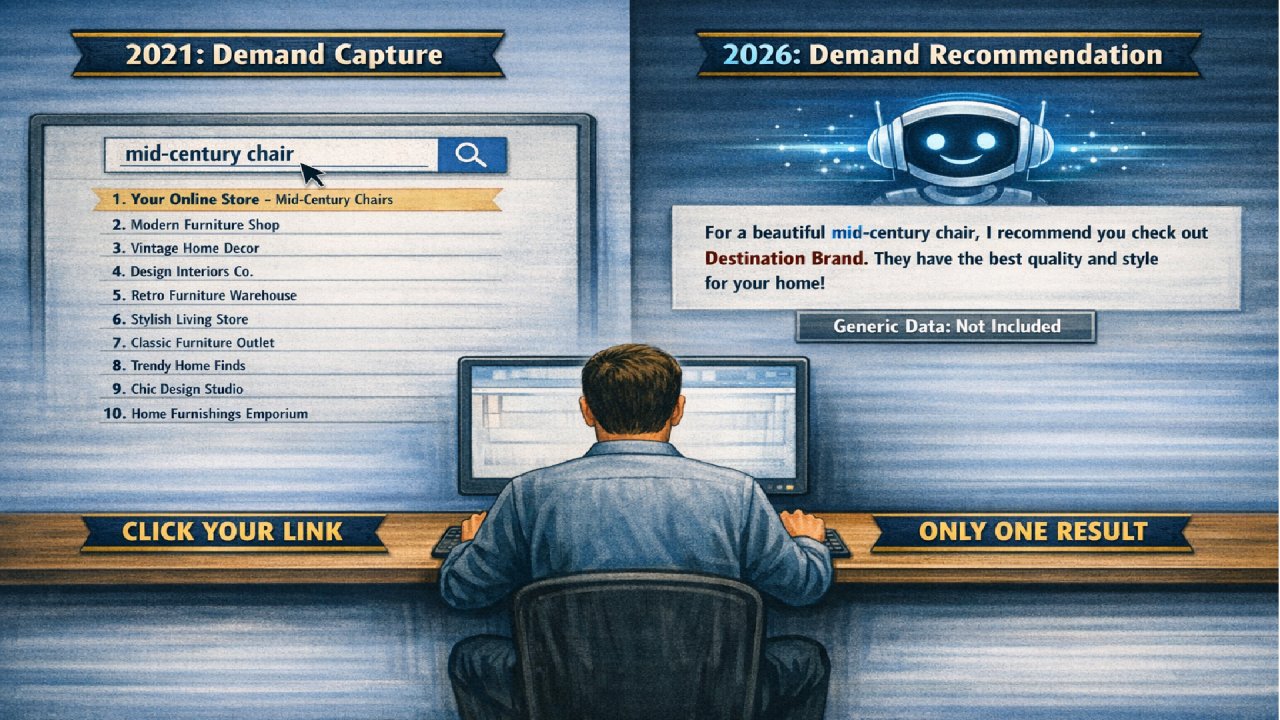
We have entered the era of AEO (Answer Engine Optimization) and GEO (Generative Engine Optimization). Search engines are no longer just lists of links, paid and organic; seemingly overnight they have become engines that synthesize answers.
When a user asks an AI assistant in 2026, "Find me a mid-century sofa for a small apartment," the AI doesn't show ten blue links. It scans the web, synthesizes reviews, and provides a Top 3 recommendation. If you are a retailer like Wayfair , with millions of unbranded products, the AI sees you as a generic commodity. It will aggregate your products into a list alongside every other discount site. You are invisible to the algorithm because the AI doesn't recognize you as authoritative in your category.
Because Airbnb spent years building a distinct identity, AI models now recognize them as the primary source for travel. When someone asks for a "treehouse in Bali," the algorithm doesn't just find a treehouse; it finds an Airbnb treehouse. They have moved from being a search result to being a cited authority.
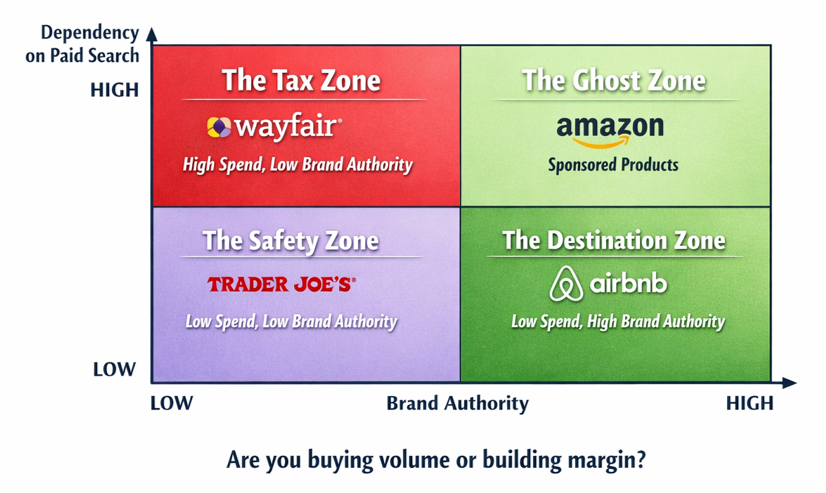
If the benefit is so clear, why is the circular acquisition tax still being paid by almost everyone?
The Nike Warning: In early 2025, Nike attempted a massive shift toward DTC and digital-led growth. When they pulled back on broad retail partnerships and performance spend, their revenue dipped, and the stock market panicked. Most CEOs see this and decide that paying the tax is safer than a short-term stock collapse.
The Identity Gap: You can't stop buying customers from Google if you don't know who they are when they arrive. Despite all the hype around AI, the required identity pivot is stalled by technical debt. According to Gartner’s 2025/2026 Digital Marketing Maturity benchmarks, while nearly all brands have prioritized first-party data, fewer than one in three have successfully implemented the identity resolution tools required to recognize a customer across fragmented devices without a third-party cookie. Most brands are still in the investigation phase, which means they are effectively flying blind and continuing to pay the circular acquisition tax because their systems can't tell a new prospect from a loyal fan.
The Keyword Addiction: KPIs continue to emphasize traffic volume, not verified identity. Teams are incentivized to deliver 1,000 cheap but anonymous clicks over 100 verified direct visitors, even if those 100 visitors are 10x more valuable.
The Takeaway for 2026
The Airbnb approach from 2021 wasn't just a cost-saving exercise; it was an identity pivot. They moved their brand from a variable expense (something they had to buy every month) to a fixed asset (something they own).
To win today, you must stop optimizing for keywords and start optimizing for entities – unique, verifiable things or brands that they can trust.
Stop Bidding: on terms that an AI is going to summarize anyway.
Start Feeding: provide structured, first-party data that allows AI engines to cite your brand as the authority in your category.
Be the Noun: if people search for the category, you pay the tax. If they search for your name, the tax is $0.
Of course, in 2026, Airbnb itself has made another pivot and are again ahead of the market – already they are moving away from search and toward AI-led conversational discovery. The lesson for your brand is clear: if you aren't positioning yourself as a destination brand with clean, structured data, the new AI bots won't even find you.
Agree or disagree? Leave your thoughts and let's start a discussion.
View original on LinkedInWant to discuss this further?
Our team thinks about these problems every day. Let's start a conversation.
Book a discovery call