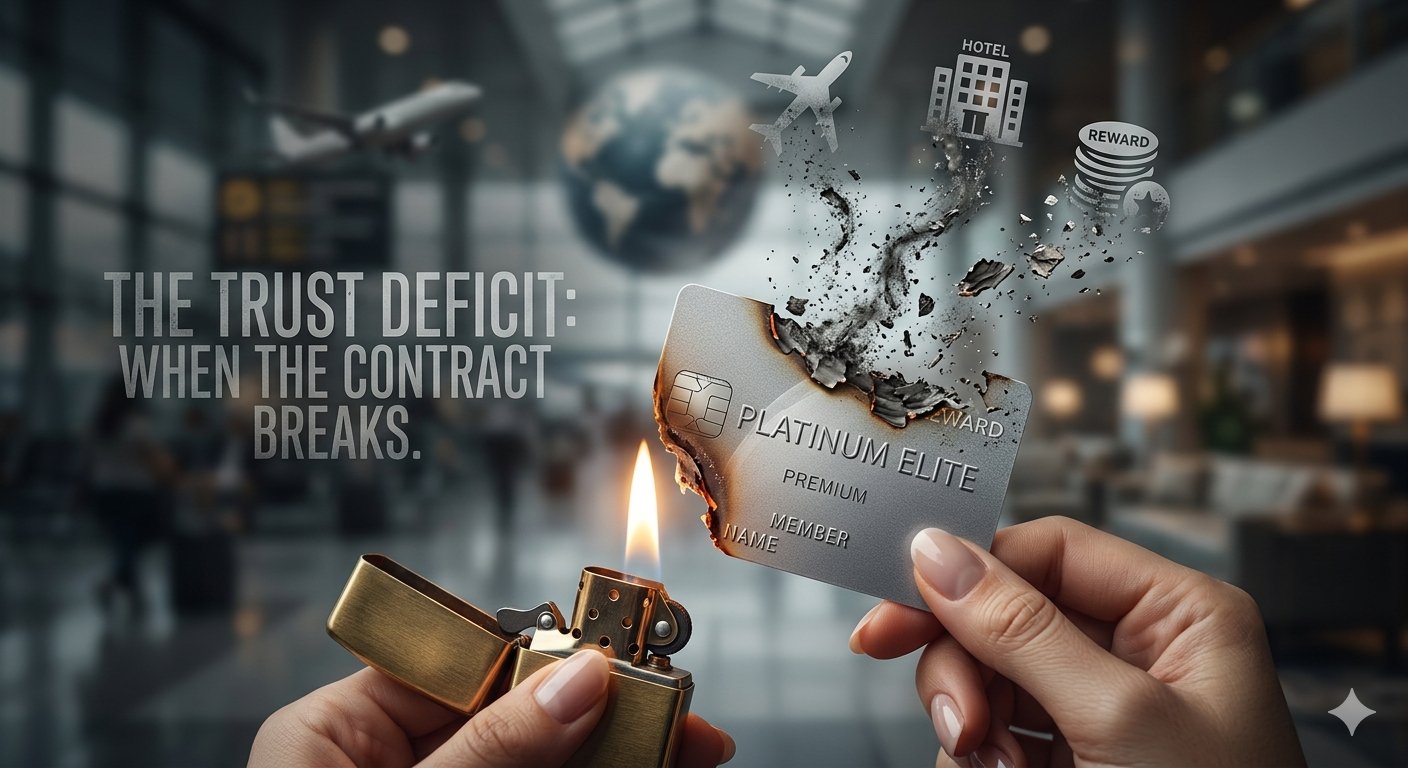
Here is the thesis, stated plainly: loyalty programs across industries are being systematically managed as financial liabilities to be minimized rather than brand assets to be protected. And the customers absorbing the most damage are, almost without exception, the highest-value ones: the people who organized meaningful parts of their lives around the relationship.
I predicted this arc a couple of years ago. We are now watching it play out in real time, and it is no longer a pattern confined to one category. It is everywhere.
It is a race to the bottom driven by short-term balance sheet engineering. In the Quick Service Restaurant (QSR) space, brands are rationing joy. SONIC launched a program that locked its signature perk - half-price drinks - behind a steep, 30-plus annual visit tier, stripping away a benefit consumers historically associated with the brand for free. The Wendy's Company sent a "Welcome to Rewards" email to existing members announcing higher redemption thresholds with the exact same creative, hoping nobody would check.
Meanwhile in travel, the damage is sharper because the stakes are higher. Take American Airlines, which recently stripped away the last remnants of elite recognition on Basic Economy fares. Status members, from Gold all the way to Executive Platinum, now forfeit complimentary seat selection and domestic upgrade eligibility, as well as points earning, on these lower-priced tickets.
The corporate defense for this is predictable: Basic Economy is for price-sensitive shoppers, so an elite flyer who buys one is breaking the loyalty contract.
This is financial gaslighting. An Executive Platinum flier who channels massive business travel through AA hubs, or a co-branded cardholder charging $15,000 a month to maintain top-tier status, has already paid their loyalty tax. Choosing a lower fare for a quick personal trip is simply rational consumer behavior.
By stripping away these perks, American is stating that your hard-earned status no longer attaches to you as a valued customer; it only attaches to the price of the ticket you bought today. The resulting math can be brutal, as shown in this simple example from some trip planning I performed this past week:
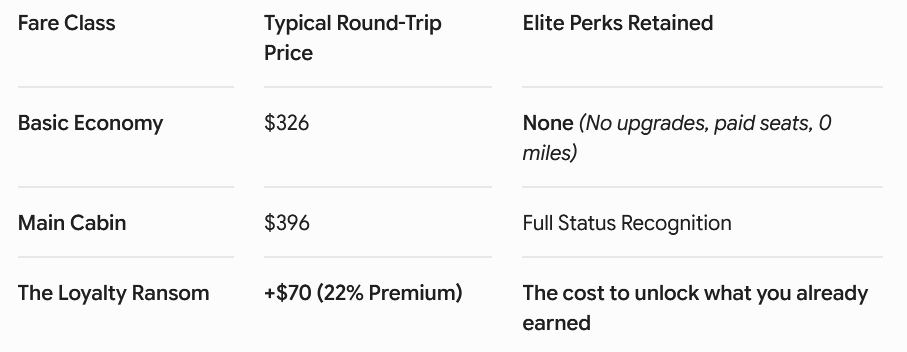
Another recent search turned up a 30% premium on a $530 ticket. Ouch.
For an elite traveler, that price gap isn't just a fare difference; it’s a ransom note to access benefits they thought they already bought and paid for.
Marriott Bonvoy has been running a slower version of the same play. By moving to dynamic pricing and completely removing published award charts, they’ve made it nearly impossible for members to know what they're working toward. Award costs at top properties have more than doubled. Multiple properties from The Ritz-Carlton Hotel Company, L.L.C. and St. Regis Hotels & Resorts now require upward of 200,000 points per night, compared to an informal cap that sat around 85,000 to 100,000 points just a few years ago. The real-world value of a Bonvoy point has eroded quietly behind a wall of algorithmic obscurity.
Every loyalty program makes an implicit promise to its best customers: your history with us means something. Status, tiers, and earned benefits exist to signal that the relationship is reciprocal. The brand acknowledges the customer's investment. The customer, in return, keeps choosing the brand, sometimes at a premium and sometimes at genuine inconvenience, because the relationship has value beyond any single transaction.
When that contract is broken, something specific and irreversible happens. The customer doesn't just disengage from the program. They disengage from the brand. And they do it with a story, one they tell colleagues, family, and anyone who will listen, because the feeling of being misled by a brand they trusted is memorable in a way that ordinary satisfaction never is.
This is what makes trust erosion so dangerous as a business decision. It doesn't register cleanly in the quarter it happens. The short-term margin protection looks like a win. The long-term relationship damage shows up later, diffusely, in declining visit frequency and brand consideration scores that nobody directly connects to the loyalty program change made eighteen months earlier.
You haven't optimized your way to profitability. You’ve traded a brand asset for a balance sheet entry - and the exchange rate is terrible.
Two programs stand out in a landscape that badly needs positive examples, proving that you can protect the business without alienating the core user.
Chick-fil-A Restaurants Chick-fil-A One has built a program that feels native to the brand: generous at entry, progressively rewarding, operationally seamless. With over 50MM members it is the largest restaurant loyalty program in the country. When adjustments have been made, they have come alongside new redemption options and expanded features. Changes feel like evolution. Members feel the relationship moving forward.
Delta Air Lines provides an instructive case on trust recovery. When Delta aggressively overhauled its SkyMiles program several years ago to tie everything to credit card spend and restrict lounge access, the backlash from top-tier Medallion members was fierce. What happened next is rare in corporate America: the CEO publicly admitted they "went too far," stepped back, and transparently adjusted the rollout. Delta realized that managing operational capacity at the expense of emotional equity was a losing bet when it came to their best customers.
Even more illuminating is Starbucks . In 2023, under the previous CEO, the brand cut rewards value while simultaneously degrading the store experience, stripping away condiment bars, raising prices, and turning cafes into sterile mobile pickup hubs. It was obviously a consultant's view of the world. Unsurprisingly, traffic plummeted, and the CEO was replaced.
But look at 2026 under Brian Niccol. Starbucks restructured its rewards again, moving away from mass-discounting to focus on true engagement, and yes, devaluing points. There was some degree of public outcry, but this time, same-store sales jumped over 7%. Why? Because the loyalty adjustments didn't happen in a vacuum. They were paired with an obsession over the core customer experience: bringing back the coffeehouse culture, returning amenities, and executing a strict four-minute service standard.
The lesson is clear: consumers will tolerate program tightening if the brand is actively investing in making the actual relationship better. Transparency and operational excellence keep disappointment from becoming betrayal.
That distinction is everything.
The brands that will build lasting loyalty share a few non-negotiable commitments.
They design for felt value, not actuarial value. If a customer needs a spreadsheet to understand whether they're getting a good deal, the program has already failed.
They treat loyalty as a brand expression, not a cost center. Every mechanic should reinforce what makes the brand worth choosing, not just what keeps the P&L clean.
When changes are necessary, they communicate with honesty, back it up with operational value, and lead with transparency.
Most critically: they remember who their best customers are, and they protect that relationship above everything else. The Executive Platinum flier who routes thousands of flights through American hubs. The Bonvoy Titanium member who has chosen Marriott properties for a decade. The everyday consumer who structures their morning routine around a single coffee brand. These are not line items. They are the foundation the brand is built on.
Treating them like they won't notice when you take something away is not a strategy. It's a bet against your own future. And across industries right now, a lot of brands are losing that bet.
The question I'd put to every loyalty and brand leader reading this: What is the one commitment you would make - structural, not aspirational - to protect the trust relationship with your best customers in 2026? And which programs, in any category, do you think are actually honoring that commitment right now?
View original on LinkedInWant to discuss this further?
Our team thinks about these problems every day. Let's start a conversation.
Book a discovery call