The marketing industry is currently performing a masterclass in semantic agility.
If you are a CMO, you are facing two conflicting realities. The first is the prevailing industry narrative: a constant stream of high-profile stories screaming about the success of hyper-personalization, like the recent article discussing The Coca-Cola Company's strategy for “de-averaging at scale.”
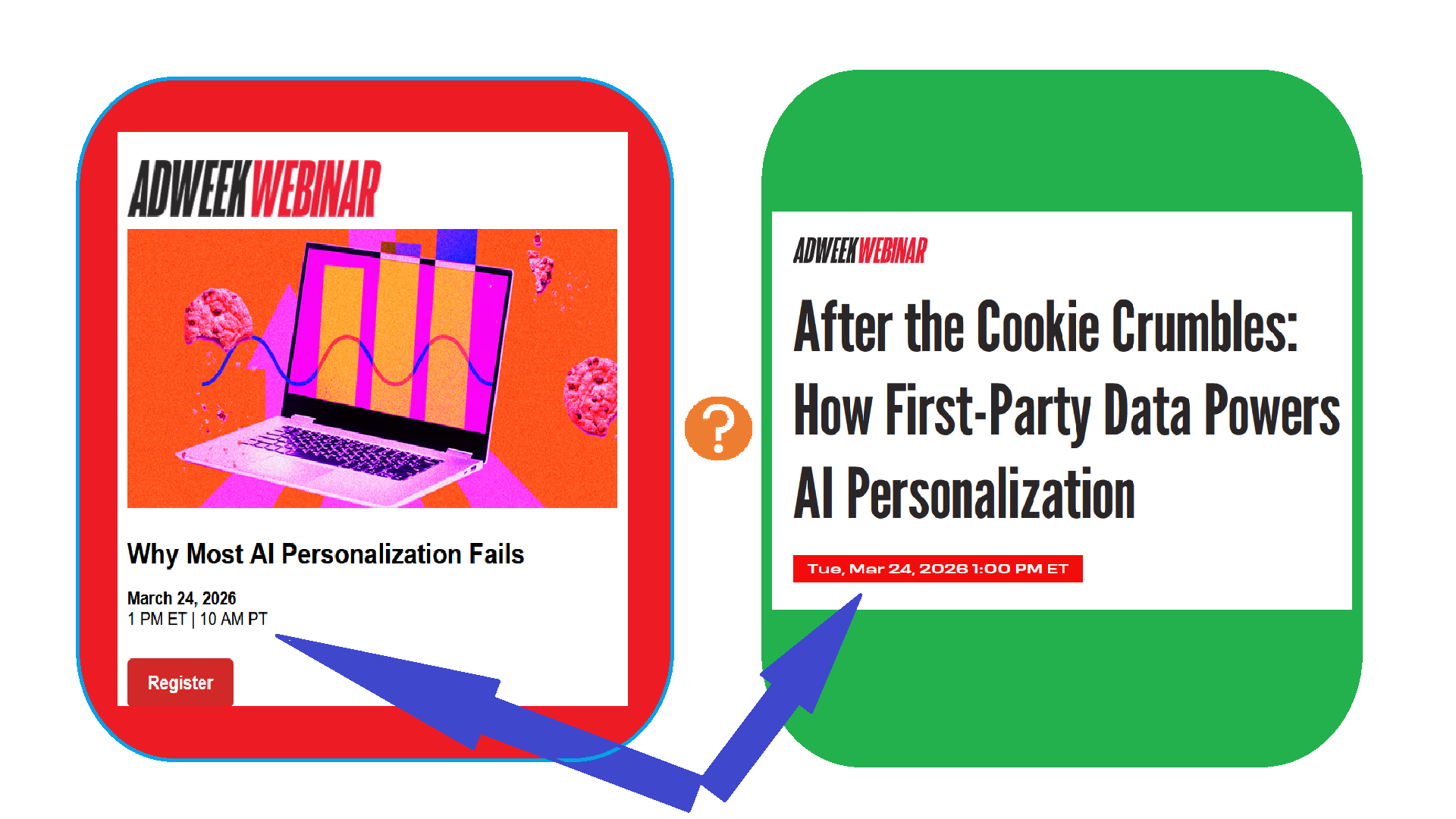
The second reality is the one that keeps some up at night, and that becomes apparent when you dig into the Coke article, and realize the tactics actually describe ZIP-level interest targeting, not personalization at all. And one that accidentally slipped out on March 20th, when ADWEEK invited its audience to a webinar entitled: “Why Most AI Personalization Fails.”
That honest acknowledgement of failure was short-lived. By March 23rd, the webinar title had been quietly rebranded to: “How First-Party Data Powers AI Personalization.” Why the pivot? Because admitting failure doesn’t sell ad tech, and doesn’t get CMOs featured in articles. The industry has too much invested in the promise of personalization to tolerate a narrative of struggle. When the ROI doesn’t materialize, the response isn't better results - it’s better spin.
Coke’s "de-averaging" is essentially a birds-of-a-feather approach. They assume everyone in a specific ZIP, where there is a significant proportion who like soccer, should see the same message. While they call this "hyper-personalization," it’s actually a white flag. It is a tacit admission that 1-to-1 marketing at scale is a logistical and financial impossibility for CPG. By retreating into "smaller buckets," they are simply rebranding geographic-based segmentation.
This isn’t surprising, as we’ve been conditioned to view mass market as a relic of the past, with AI and other emerging technologies bringing 1-1 marketing closer to reality, but for brands like Coke, that broader reach is the engine of growth.
A decade ago, Procter & Gamble's Chief Brand Officer Marc S. Pritchard famously sounded the alarm when he realized they had "targeted too much" and gone "too narrow." P&G had spent significant effort testing personalization approaches and was using Facebook’s granular data to target Febreze ads specifically at pet owners and large families, assuming these were the only micro-segments that mattered.
The result? Sales stagnated. The fix? Pritchard pulled back, stopped the niche targeting, and returned to messaging anyone over the age of 18. Sales immediately went up.
As the P&G lesson taught us, volume isn't driven solely by a brand’s biggest fans or high-frequency segments. It is sustained by the long tail of occasional buyers. When you focus only on the most attractive personalized niches, you stop casting the wide net required to catch the person who buys your product once in a while, or buys for a smaller household. Those occasional purchases, when aggregated across the population, drive a significant degree of the volume that builds icons. In 2026, the bravest thing a CMO can do is defend the broad reach that builds mental availability and keeps your brand top of mind.
Personalization should enhance the brand’s presence, not fragment it into a thousand invisible pieces, and certainly not act as the sole lever of strategy.
We have all seen the slides. McKinsey and BCG are frequently cited as the source of stats suggesting that personalization drives a 15-25% lift in incremental revenue. My question is always the same: Where is the durable, sustainable example? Does that mythical 25% lift account for the massive overhead of data science teams, AI licensing, and the exponential cost of creative versioning? Consultancies make it seem like a software switch. In reality, it’s often a high-cost treadmill that ignores the fundamental role of brand-building. This is not an argument against personalization, only a reminder that personalization has a role, but only as one among many tactics. And if you can't show that it drives profitable, incremental spend, it's tough to justify the incremental cost.
Three Moves for the 2026 CMO
If you want personalization to deliver more than just a headline, you need to demand a different level of accountability:
1. Reject the "De-Averaging" Rebrand If your team brings you a hyper-personalization plan based on ZIP codes or broad cohorts, call it what it is: segmentation. Segmentation is a proven and effective tactic, but it shouldn't carry the hyper-personalization price tag or the complexity of an AI-driven overhaul.
2. Measure the "Occasional Buyer" Lift Stop optimizing only for your heavy users. You can also use AI and advanced analytics to measure whether your efforts are actually converting the light buyers who are essential to category growth. If your AI is just talking to the people who were going to buy anyway, you are wasting your budget.
3. The Global Hold-Out is Non-Negotiable Don't accept attributed revenue. Demand a global hold-out group that sees a standard, high-quality mass-market brand message. If the personalized group doesn't outperform the mass-market group by a margin that covers its own tech and creative costs, re-think the investment.
The industry can change the title of the webinar on Monday morning, but as a CMO, you have to live with the P&L on Friday afternoon.
The CMO Challenge: Have you audited your "Personalization P&L" lately? Are you paying an AI Tax for results that a high-quality mass-market message could achieve at a fraction of the cost? How do you know?
I'd love to hear from practitioners about their experiences – and results – from personalization. Is "de-averaging" a breakthrough for you, or is it just the latest rebranding of a legacy tactic?
View original on LinkedInWant to discuss this further?
Our team thinks about these problems every day. Let's start a conversation.
Book a discovery call