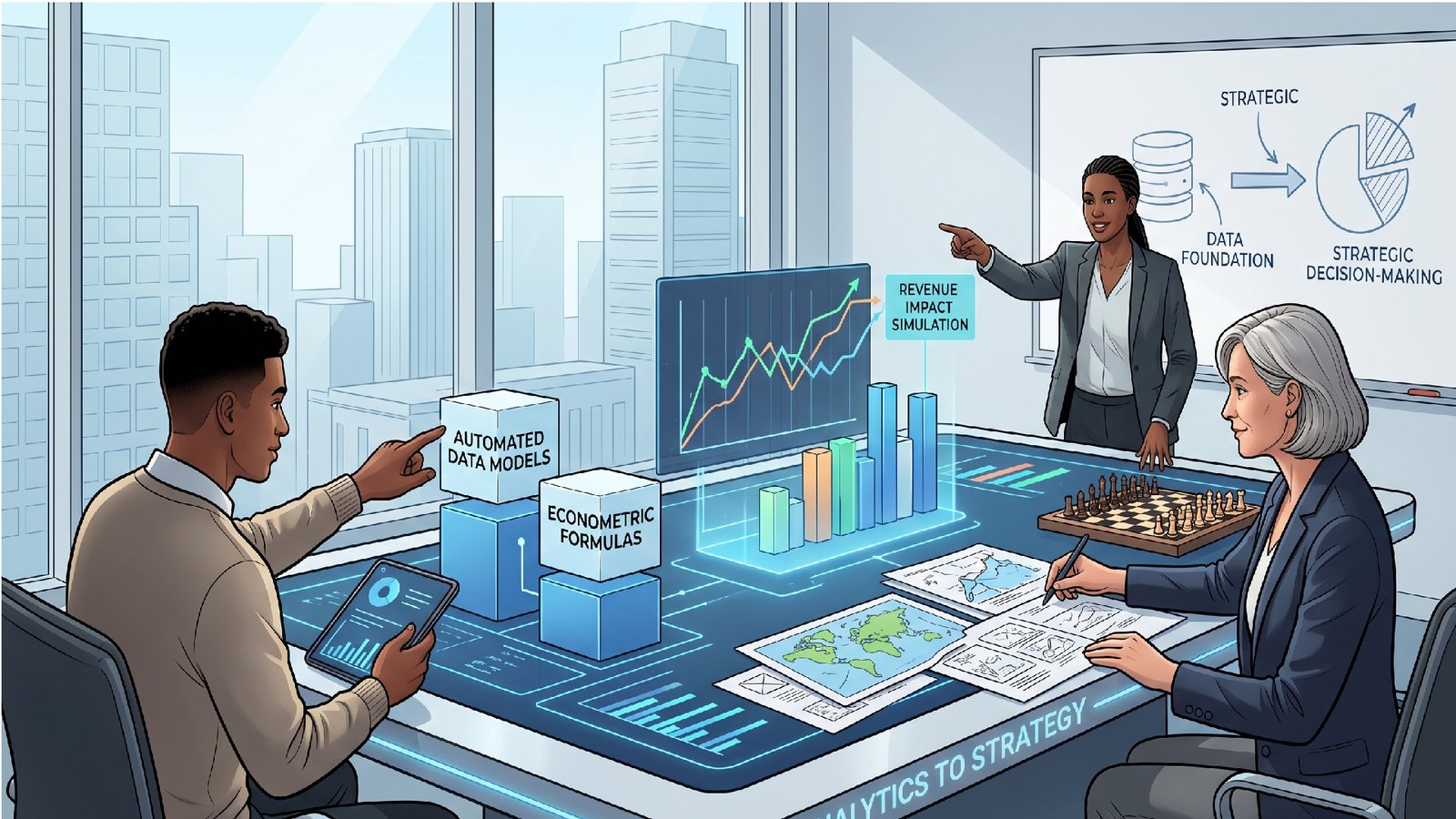
Over and over, the marketing industry repeats the same well-intentioned mantras: Clean up your data. Own your tech stack. Transition from data-builders to data-translators. We’ve heard it – or been saying it - for years, and it has gotten louder with the advent of AI. It’s sound advice, but it’s no longer innovative thought leadership.
More recently, with the release of more advanced AI models from all the major players, and especially tools like Claude Code, it feels like the ground has shifted beneath our feet with regards to marketing analytics. It's time to stop talking about messy data and to focus on more expansive thinking about what comes next.
What do I mean? The old ways of building a marketing analytics function are gone, and what’s required to replace them is still taking shape. To see this in action, consider as an example what is happening with Media Mix Modeling (MMM). Historically, MMM has gone in and out of favor, not least because it often required a six-figure retainer and several months for a consultant to hand over a static report and an abstract equation that was difficult to operationalize. It was the epitome of a 'black box' process: expensive, backward-looking, and disconnected from real-time execution.
But the black box is being shattered from both ends of the market.
The Corporate Shift: As reported by Digiday recently, The Hershey Company spent a year building a foundation of AI agents to completely insource and automate their media modeling going forward. What used to take months now takes weeks, allowing them to instantly shift budgets into hyper-relevant channels like Reddit, and to drive higher ROI on working budget while at the same time reducing non-working budget.
The Skunkworks Disruption: On the other end of the spectrum, an agency analytics leader recently shared a story about a junior team member, with little to no training in econometric theory, who used an AI coding assistant to build an MMM from scratch - over a weekend. When the more seasoned executive reviewed the output, he was shocked. It held together. The model didn’t just spit out a formula. It delivered sound market logic. It was cohesive, contextually accurate, and immediately actionable, completely making obsolete the weeks of manual tweaking usually required by an experienced data scientist to make the model make sense.
When a Fortune 500 giant automates enterprise measurement in weeks, and an agency rookie builds a viable model over a weekend for zero incremental dollars, it’s time to stop talking about basic data hygiene platitudes. Multi-touch attribution, customer lifetime value modeling, and behavioral segmentation are no longer specialized skills. They are utilities. They are software features.
The takeaway is that any marketing analytics task that relies on rote execution, standardized formulas, or structured data engineering is about to become a zero-cost commodity.
The real trap for marketing executives is getting caught up in incremental thinking: using a new set of advanced tools just to do the same exact things tomorrow, only a little faster. The true opportunity is expansive thinking: anticipating that these tools will completely free us from the rote tasks of today, enabling us to envision and build a completely new tomorrow.
This suggests organizations need to be developing two parallel work streams. The first is operational: aggressively finishing the AI-driven automation of standard reporting and analysis functions. The second is visionary: defining a future where analytics investment is focused almost entirely on the strategic savants who can interpret data and deploy highly impactful tactics.
If you are a marketing leader looking to navigate this shift, you cannot afford to treat AI as a mere cost-cutting tool. You must run two tracks simultaneously:
Track 1: Mandate Back-Office Automation (The Efficiency Stream): Stop tinkering. Set a hard deadline to automate your standard segmentation algorithms, rote regression models, reporting functions and data cleaning. Treat back-office analytics as a pure utility that should run seamlessly in the background, primarily via agentic software with minimal human oversight.
Track 2: Invest heavily in "Insight Savants" (The Effectiveness Stream): Shift the dollars saved from Track 1 into hiring and empowering people with deep commercial intuition. These are the strategists who don't just stare at charts or know how to construct a segmentation model. Instead, they pressure-test and tweak the AI's logic, connect the dots to consumer behavior, and shape the output into sharp, insight-driven strategies.
And of course, the critical enabler for both: Own the Foundation. Brands should follow Hershey’s lead. Own your data contracts and platform seats directly. Your data foundation isn't an IT project; it is the proprietary fuel for your AI. If you don't own the foundation, you can't build the strategic layer on top of it.
When the standard functions of marketing analytics become completely automated, what is the number one problem you want your teams to solve next? Are you ready to stop chasing incremental efficiency and start investing in the insight savants who will build tomorrow’s strategy?
Start a dialogue in the comments.
View original on LinkedInWant to discuss this further?
Our team thinks about these problems every day. Let's start a conversation.
Book a discovery call