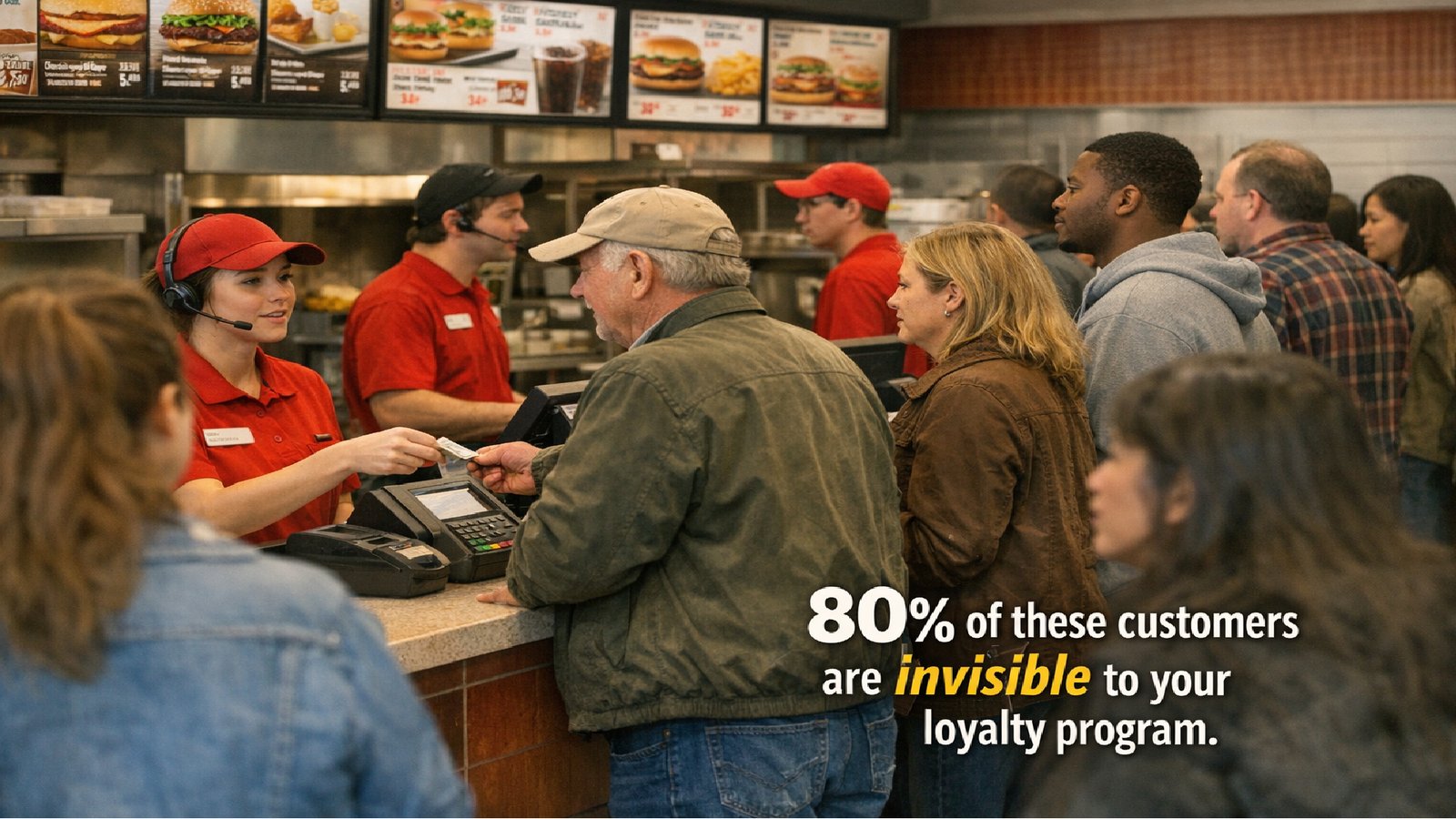
(And why focusing on enrollment won’t solve the problem)
On April 13, Chipotle Mexican Grill announced the re-launch of it’s loyalty program with "Rewards on Repeat". Nothing groundbreaking or especially innovative with these changes, and Cecilia Floridi does a nice job breaking down the re-launch and implications, so no reason for me to add anything around that. What stands out to me separately is that as part of this re-launch, Chipotle is doubling down on in-store enrollment.
Why are they doing this?
Chipotle has a stubborn data problem: nearly 90% of digital transactions are linked to loyalty, compared to only about 20% of in-restaurant transactions. Management seems to believe this 70-point gap represents a mass of unidentified consumers waiting to be signed up.
But... what if they’re looking at this the wrong way? This 70-point gap is one of the clearest examples in the industry of how a program can reach massive scale and still leave billions in long-term value on the table by continuing to prioritize acquisition over recognition and engagement, long past the point of diminishing returns. And the program re-launch doesn’t go far enough to engage casual or lapsed users.
The standard explanation for this gap: unlike in-store, the app forces loyalty program membership and transaction linkage, and the super-fans have migrated to digital ordering en masse. But the deeper issue is a long-standing strategic trade-off. Chipotle has historically opposed register friction that threatens its legendary throughput, including simple approaches like phone number lookups. They have consistently prioritized the speed of the line over data capture.
Their published intention to emphasize in-store enrollment raises a critical question: what is the ceiling on the size of their loyalty database? The membership line has seen a remarkably steep, linear climb since the original program launch in 2019, with recent member growth even surpassing revenue growth. Since brand fans are typically early adopters, it is difficult to imagine a huge pool of untapped members-in-waiting. Yet management is betting they can shift the slope of their member growth even higher through crew incentives and in-store signage.
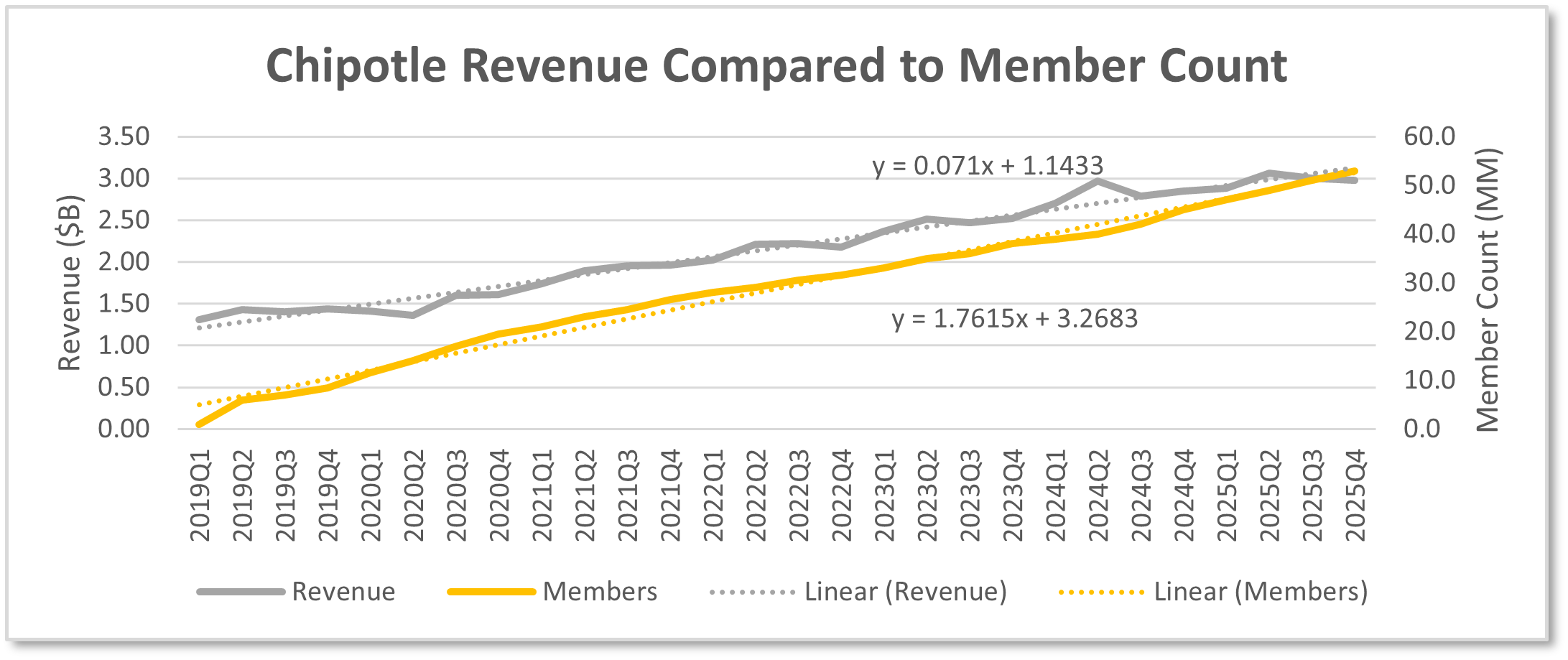
Can we estimate what Chipotle’s ceiling may be? A deeper look at household penetration data, benchmarked against Starbucks , as the category leader, may provide some insight.
Per Numerator, Starbucks has 68% household penetration, meaning approximately 81.6 million households. Assuming 1.2 users per household, a number I’ve used in the past that seems to hold up, that means 97.9 million potential program members. If we assume that the 35.5 million actives represent 50% of total, that implies total U.S. membership is 71 million, or 72.5% penetration of the potential audience. Let’s use that as the high point others might hope to achieve, and the formula for any brand is:
Membership Ceiling = 120MM Households x HH penetration x 1.2 members per HH x .725 (Starbucks benchmark)
Chipotle has 56% household penetration per Numerator. With 50 million members already, the formula suggests Chipotle has captured roughly 62% of its potential. Using the Starbucks benchmark, the ceiling for Chipotle loyalty would therefore be approximately 58.5 million members, compared to the 50 million existing members.
For Chipotle, there is simply not much headroom left. Adding tens of millions of new members is statistically unlikely. The real opportunity lies in reactivating the 29 million dormant accounts and eliminating the friction that keeps existing members invisible at the register, ensuring every transaction actually gets tied back to a member profile.
The mechanics at the point of sale make identification difficult. To earn or redeem at the counter, guests must open the app, pull up the QR code, and have a crew member scan it before the order is finalized. In a busy line, that’s a high-friction moment. Crew incentives and new signage help with new sign-ups, but they do less for the millions of existing members who still order at the counter without ever being recognized.
The value perception compounds the inertia. A review of the rewards schedule suggests Chipotle’s average “giveback” on purchases is just 6.3%, noticeably lower than the 8–12% range many competitors deliver. For a casual member, the math simply may not warrant the effort to identify themselves at the register.
If your digital loyalty attachment is strong but in-store linkage lags, treat this as a strategic audit, not another marketing campaign. Here’s the playbook:
1. Measure the real gap. Pull your last 30 days of transaction data: % of digital orders linked to loyalty vs. % of in-store orders linked. Be brutally honest. Reducing that single number becomes your key objective.
2. Map every second of the counter experience. You’re likely already doing that, but from the perspective of efficiency. Walk the line as a customer. Where does the “prove you’re a member” moment happen? How many extra seconds does it add? If it breaks flow, redesign it. Phone-number lookup, one-tap digital wallet, or a quick “Rewards?” prompt from crew may beat any new reward tier.
3. Re-price the value proposition for the casual diner. If your giveback sits in the low single digits while competitors are higher, the math has to feel generous to keep casual members engaged, and reinforcement at the point of sale is crucial. Test different everyday earn rates on core items or instant micro-rewards that close the perceived-value gap.
4. Make identification the default, not the exception. Once enrollment is healthy, shift budget from sign-up incentives to seamless recognition tech and incentivize crew habits to increase loyalty attachment at register. Loyalty compounds only when every transaction, both digital and physical, builds the same customer record.
5. Run the experiment for 90 days. Pick a representative sample of stores, implement the friction fixes and value tweaks, and track lift in linked in-store transactions, average basket size, and visit frequency. The ROI case will write itself.
Chipotle’s own data shows what’s at stake: frequency, basket size, lifetime value, and proprietary first-party insight across all customers, not just digital-first customers. The brands that close the identification gap fastest will own the next decade of restaurant loyalty. The rest will keep wondering why their best customers only show up in the app.
What’s the biggest friction you have seen in your in-store loyalty flow? Drop it in the comments and start a discussion.
View original on LinkedInWant to discuss this further?
Our team thinks about these problems every day. Let's start a conversation.
Book a discovery call