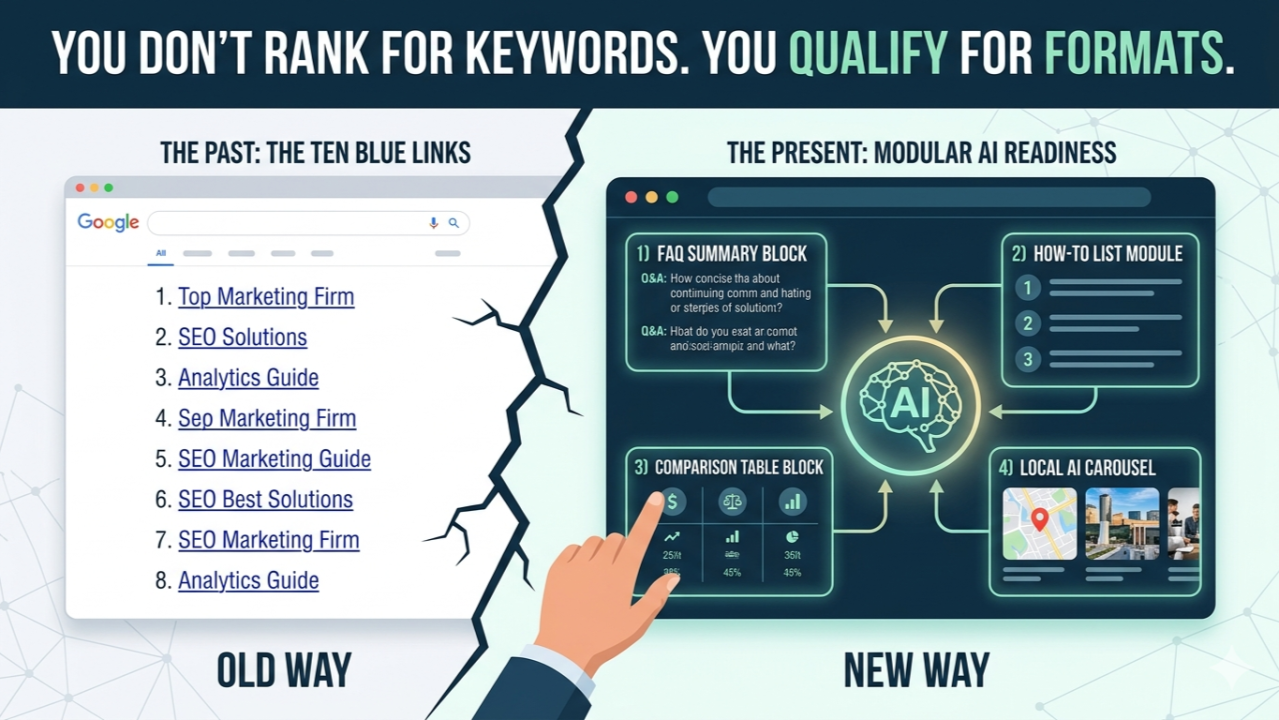
A few months ago, we spent some time with a home services business talking about optimizing their GBP and strategies for the new reality of search in the context of changes Google made to their algorithm and interface. One thing we stressed is that it's not a one-off, it's an ever-evolving area of concern, and as this article makes clear, if your marketing team is still celebrating "ranking page 1 on Google," it might be time to take a look at what page 1 actually looks like today.
We’ve moved completely past the era of ten blue links. Today, Google Search is a highly fragmented mosaic of AI Overviews, interactive carousels, dynamic maps, and modular "How-To" lists.
This has completely changed the math behind digital visibility. Large Language Models like Gemini don't read your carefully crafted, 2,000-word narrative essays the way a human does. Instead, they extract discrete fragments, including definitions, direct claims, tables, and structured data blocks, and reassemble them into a custom answer directly on the search page.
The hard truth of 2026 search strategy? AI extracts fragments, not pages.
If a brand's data isn't structured to be modular and extractable at the section level, it simply ceases to exist to the AI layer.
To navigate this shift, mid-market and enterprise brands need to fundamentally re-architect how their digital footprints are built. It requires moving from basic keyword targeting to what can be called a Modular Readiness Framework:
From Topic Clusters to Answer-First Architecture: Instead of burying the lede inside a long introductory narrative, the complete, definitive answer to a customer's question must live in the first 50–70 words of a section. The AI needs a clear conclusion it can cite immediately before it bothers reading the supporting details.
Engineering for Multiple Reponse Formats: A single piece of content can no longer just be paragraphs of text. To qualify for Google's various AI modules, the data must be structurally diverse. Think: numbered blocks for sequential processes, clean tables for comparison metrics, and explicit FAQ schemas for immediate definitions.
Prioritizing Reference Rates over Click-Through Rates: When users get their answers directly on the search engine page without clicking through to a website, traditional traffic metrics become a vanity project. The new metric of consequence is your "Share of Model" (SoM): how frequently and accurately an AI engine references your data as the trusted source of authority.
Take a look at your top-performing blog post or service page right now. If an AI engine parsed that page and was only allowed to extract one isolated 4-sentence block to answer a user's prompt, would it make complete sense on its own? Or is your valuable expertise trapped inside an un-parsable wall of text?
Agencies selling "AI SEO" often treat this like a hidden magic trick. It isn't magic. It's an operational discipline around how information is structured, formatted, and published.
The companies winning the visibility game right now aren't the ones writing the most content; they are the ones building the most usable data blocks for the machines that recommend them.
View original on LinkedInWant to discuss this further?
Our team thinks about these problems every day. Let's start a conversation.
Book a discovery call